It’s not every day you get a nod from The Tutors’ Association, but today’s that day! We’re absolutely delighted that Green Tutors has been recognised for our commitment to making STEM education accessible, inspiring, and downright brilliant. We’re shortlisted for Tuition Business of the Year for the second year in a row.
This nomination isn’t just about us. It’s about every student we’ve helped, every tutor who’s gone the extra mile, and every parent who’s trusted us to guide their child’s learning journey.
So here’s to all of you: thank you for helping us get here. We can’t wait to keep pushing boundaries, smashing goals, and making a difference—one lesson at a time.
People’s Choice Award – Get Voting!
As a shortlisted candidate, we’re now also eligible for the People’s Choice Award, where the public can vote for the individual or organisation they’d most like to see win.
We’d very much appreciate your vote, but there are lots of excellent businesses, partners, and collaborators on this list.
Lucy Oldershaw, our outstanding pillar of admin at Green Tutors, has been shortlisted for Outstanding Team Member in Tuition. I thoroughly recommend a vote for Lucy. She’s been working with us since 2023 and we couldn’t cope without her.
NavigatEd Tutor, sponsor of the STEM Stories podcast, and a training provider for our tutor team, is shortlisted for Tuition Partner of the Year, as well as Professional Services for Tuition.
Tutorbird, our administrative platform for the past four years, has also been shortlisted for Tuition Partner of the Year and Technology Tools for Tuition.
Elevated Support Ltd, who have provided Green Tutors with excellent administrative support for the past few years, are shortlisted for Professional Services for Tuition.
Pedagogical Tips for Tutors, the fantastic free CPD community that is part of our tutor onboarding training, has been shortlisted for Professional Services for Tuition.
The Maths Hub for Tutors, which was part of our CPD in 2024 and 2025, has been shortlisted for Professional Services for Tuition.
The Education Hotel, our referral partner for services we are not able to directly support, has been shortlisted for Private Tutoring Provider.
Pencil Spaces, our tuition platform of choice, has been shortlisted for Technology Tools for Tuition.
Education Boutique, who Georgina has worked with for AP tutoring, has been shortlisted for Alternative Provision Provider.
Alongside this, many of our friends and collaborators are listed for awards. With such excellent support, it is no surprise that we’ve made our way on to this list. We take what we do very seriously, and so we only work with others who feel the same about delivering quality education and reliable service.
Whatever the outcome of the awards, we’ll be celebrating our nomination in style at the awards ceremony. Photos to follow!
It’s frustrating to spend time on revision that doesn’t work. Its understandable to lose motivation. And as you get further through the calendar year and closer to exams, the pressure and the procrastination guilt builds, and it gets even harder to see where to start.
What’s the big secret to why revision doesn’t work?
Here’s the secret – it isn’t your fault. Let’s come at it from a different angle.
Do you ever feel like there’s a secret trick that everyone is keeping to themselves, that makes life easier?
The secret that they are keeping to themselves is that they do things wrong way more often than they do things right.
Even the simplest of daily tasks, like brushing your teeth, had to be learned and went wrong a lot before it went right. Just ask your parents!
There’s absolutely no reason for revision to be any different to that, and so the trick is to expect it to go wrong a lot, before it starts to go right.
So what doesn’t work in revision?
Don’t be disheartened – we can speed up the process a bit by sharing best practices. Just like your parents supported you to learn how to brush your teeth well, you can be supported to learn how to revise well.
So if there’s a right way, then there’s a wrong way.
Unfortunately that means less of the ‘fun’ polished notes, pastel highlighters, washi tape process of revision, and more of the thinking and doing.
What really matters when revising is building clear, retrievable memories that match your learning goals.
So if you’re learning about Pythagoras’ Theorem, you are aiming to understand what it is, when it is applied, and how to apply it. And that understanding needs to find a secure spot in your brain where you will be able to find it again.
The ability to find it again is based on how often the path to its door is walked. Which practically speaking means how often we are using that information. Which is, I’m afraid, the reason for repetitive homework.
But that homework is much more effective when it isn’t all done at once. Spaced retrieval of that information – reviewing it daily for a few minutes – is much more effective.
How do we put that into practice?
Making your notes to revise from is the least effective and yet often most time consuming part of the process. The good news is that you can shrink the time needed with ready made notes, like the ones we provide in our online drive for students.
You can purchase great notes from CGP Books, or from online libraries like Save My Exams. That means you have all of the information to hand in a clear format, and your task is to get your brain working with it to keep hold of it.
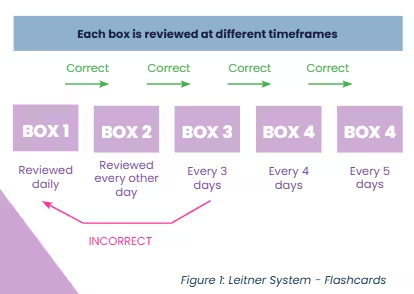
For example, having a pile of flashcards can be part of a daily retrieval practice for information (that you already understand but need to recall).
Using the Leitner system, with stacks of flashcards, is something that you can build into existing daily routines with very little effort. But it will make a big impact on your progress towards your learning goals.
What are the key requirements for revision to work?
There is lots of brain science around how to make learning more impactful. I’m happy to have a chat about it if you’re interested, but that’s probably not what you came here for. You already have enough to learn!
So let’s focus on specific actions you can take that will make your task easier.
Your learning, whatever you are learning, follows a few key steps:
Understand the content
Apply the content with support (e.g. textbook, tutor, teacher)
Remember the content
Apply the content independently (from memory, with understanding)
Build on the content with new learning.
This is the way that school curricula are built. There are essentially the same topics each year from reception to A level, but the content each year builds on the content from the previous year.
Lots of learning activities don’t complete this journey. You can read and understand something, but if you don’t remember it well enough to apply it to exam questions, you haven’t really learned it.
Ultimately academic learning is demonstrated with exam performance (unfortunately), so we have to bear that in mind when we are making study choices.
So to work towards learning, we have to actively follow the steps.
What might this look like in practice?
Let’s say you’re aiming to learn about photosynthesis. You first need to understand the process of photosynthesis.
While all of that information is fresh in my mind, I would think of a way to document the key information on a single page. In order to do that, I have to understand it and organise it. That is the first step in organising the memories in my brain, making it easier to recall them later.
Having done this, I would apply the content with some exam questions on photosynthesis. This is the best way to apply our learning as it mimics the assessment we are preparing for at school. But there’s all sorts of ways you can apply the content, and show how well you remember it.
In doing this, I would identify how often I can answer from memory and how often I need to reference my notes. That shows me what I am remembering and what I am not.
I can repeat this process, or else I can try different things like flashcards, quizzes, or anything else that requires me to recall and apply the content.
If you’re still feeling stuck, we can work on this together with a revision workshop. It will help you to break the mountain-sized task down into manageable steps, with specific, simple actions you can follow.
I’d love to have a chat about this with you. Send me a message at Georgina@GreenTutors.co.uk with any challenges you’re facing in revision.
As students, we often focus on studying hard and revising thoroughly to ace our GCSEs. However, one of the most underrated ways to improve your exam performance is to focus on your sleep. Quality sleep is crucial for processing information, consolidating memories, and ensuring you wake up refreshed and ready for the day. Here are seven essential tips to enhance your sleep hygiene and boost your GCSE success.
https://youtu.be/1v6Iuk4WcEE
1. Maintain a Regular Sleep Schedule
Creating a consistent sleep schedule is vital. Try to go to bed and wake up at the same time every day, even on weekends. This helps regulate your body’s internal clock, making it easier to fall asleep and wake up naturally.
2. Aim for 9 Hours of Sleep
Teenagers need around 9 hours of sleep per night. This may seem like a lot, but it’s essential for optimal cognitive function and overall health. Make sleep a priority to ensure you’re well-rested and ready to tackle your studies.
Can you reduce the time you need to get ready in the mornings by getting things ready in the evening? Can you pre-pack your lunch box and school bag? Can you make a list of what you need to remember in the morning?
3. Track Your Sleep
Use an app or a smart watch to track your sleep patterns. These tools can provide insights into your sleep quality and help you identify any issues that might be disrupting your rest.
I found I was waking up a few minutes at a time, which added up to about an hour over the course of the night. This means that for 8 hours in bed, I was getting 7 hours of sleep at best. The chances are you aren’t getting as much sleep as you’d like.
4. Use Ear Plugs
Noise can be a significant disruptor of sleep. If you live in a noisy environment, consider using ear plugs to create a quieter sleeping space. This simple tool can help you stay asleep throughout the night.
I use Loop ear plugs to improve my sleep as they’re comfortable to wear at night. It means that I can forget about them and fall asleep more easily, even if other members of the household are on different sleep schedules, and the cat is moving about the room.
5. Block Out Light
Light exposure can interfere with your ability to fall asleep. Use blackout curtains or an eye mask to keep your room as dark as possible. This encourages the production of melatonin, the hormone that regulates sleep.
Your bed should be a sanctuary for sleep, not a place for work. Doing homework in bed can make it harder for your brain to associate the space with rest. Create a separate, comfortable workspace to keep your sleep environment peaceful.
Can you separate your desk and bed with a room divider? Or even some stick-on wallpaper around either the desk or the bed to separate the two areas by design will help you to separate the spaces mentally, and move from one to the other.
7. Keep Your Room Cool and Ventilated
A cool, well-ventilated room can significantly improve your sleep quality. If it’s safe to do so, open a window to allow fresh air to circulate. Just ensure your room is secure and you stay warm enough.
If you don’t already have a latch on your window, you can add one to make it secure while ventilating your room.
Conclusion
Incorporating these sleep tips into your routine can help you perform better in your GCSEs by ensuring you’re well-rested and alert. For more comprehensive guidance on managing your study schedule and wellbeing, check out our GCSE Success Planner. It includes monthly wellbeing tips, study schedules, and practical advice to help you stay on top of your game throughout the academic year. Invest in your success today and make your GCSE journey smoother and more manageable.
In this video, Cai Graham and I discuss effective strategies and expert STEM tutoring to boost learning and reduce exam stress. As we entered into 2023, I had an insightful discussion with Cai Graham, an expert in stress management and effective study techniques. Here’s a recap of our conversation, packed with actionable advice to help your child thrive academically and emotionally.
1. Implementing the Pomodoro Technique for Effective Study Sessions
One of the standout strategies we discussed is the Pomodoro Technique, a time-management method that promotes productivity and focus:
Focused Intervals: Work for 20 minutes, followed by a 5-minute break. This short, intense focus helps maintain concentration and prevent burnout.
Scheduled Breaks: Regular breaks are essential for mental rejuvenation and maintaining sustained attention.
Encourage your child to use this technique to break their study time into manageable segments, making the study process less daunting and more productive.
2. Breaking Down Study Material into Manageable Chunks
A common challenge for students is feeling overwhelmed by the sheer volume of material. Cai’s advice is:
Chunking: Divide study material into smaller, more digestible sections or modules.
Prioritisation: Start with the least favourite subjects first when energy levels are high, then move on to more enjoyable topics later.
By organising study material into smaller chunks and prioritising tasks, students can reduce overwhelm and improve their focus.
3. Managing Stress and Anxiety: Practical Techniques
Understanding and managing stress is crucial for exam success. Cai shared practical techniques to help your child manage stress:
Box Breathing: This technique involves breathing in for four seconds, pausing, exhaling for four seconds, and pausing again. It calms the brain’s stress response and is easy to practice anywhere.
Identifying Triggers: Help your child recognize their stress triggers and develop personalised coping strategies.
These stress management techniques can help your child stay calm and focused during their study sessions and exams.
4. Embracing Compassionate Parenting
Support during exam periods involves balancing understanding and expectations:
Self-Compassion: As a parent, be kind to yourself and acknowledge the challenges you face. Adapt your approach to fit your family’s needs.
Mentoring Approach: Rather than managing every detail, mentor your child, offering guidance and support tailored to their individual needs.
Creating a supportive environment that accommodates your child’s unique needs can lead to better outcomes and reduce stress.
5. The Role of STEM Tutoring in Exam Preparation
If you’re looking for additional support for your child, professional tutoring can make a significant difference:
Customised Learning Plans: We offer tailored STEM tutoring that addresses your child’s specific needs and strengths.
Integrated Techniques: Our tutoring incorporates effective study and stress management techniques like the Pomodoro Technique and breathing exercises.
Boosting Confidence: We aim to build your child’s confidence and help them overcome academic challenges.
For personalized support and guidance, consider reaching out to us at Green Tutors.
Contact Us
To explore how our STEM tutoring services can benefit your child, contact Georgina Green at georgina@greentutors.co.uk. We’re here to provide the expert support your child needs to excel in their GCSEs and A-Levels.
Together, we can turn exam stress into success. Empower your child with the right tools and support to achieve their best in 2025.
As an exam tutor, building your child’s confidence is probably the most important part of my job.
Because we know from our own experiences that we need to believe in a positive outcome to take a chance on doing something scary. When we feel confident we’re more likely to take action towards our goals.
So it makes a massive difference to your child’s wellbeing to have more confidence in themselves.
According to this article from Psychology Today, confidence is something that we can grow. It certainly isn’t fixed, so even the most self-critical students can turn this around.
So where does your child’s confidence come from?
The only way we are able to have more confidence in what we can do is by doing things before we are ready. This means taking small steps just outside of your comfort zone.
This needs to be a measured approach. If we go too far out of the comfort zone into completely unfamiliar territory with no support, that leads to overwhelm. The brain and body protects itself in this scenario by shutting down executive functions and turning on ‘fight, flight, or freeze’ functions. That is not what we want for academic performance, as the executive functions are exactly what we need to use.
If we stay close in the comfort zone, with lots of help and safety, there is no learning. Growth never happens in this zone, because it is not needed. We don’t have any experiences to learn from. We don’t try things. It isn’t where we need to be when we are trying to improve in any way.
So it makes sense then that when working towards an academic goal, there needs to be a consistent and manageable amount of stretch. There needs to be room to make mistakes, but no penalty for doing so. We just pick up and carry on with our new experience.
How can we build confidence into learning?
Often anxious students are afraid of getting things wrong, and then afraid that other people will judge them for it. It isn’t so bad to make mistakes when no one knows, although that can still result in a lot of negative self talk. But if other people notice our ‘failures’ it can feel embarrassing.
Because that is a large part of human nature, most of us behave that way most of the time. So we are seeing ourselves make mistakes a lot more frequently than we see others making mistakes.
Understandably this can lead to the belief that we are not as good at learning as others are.
For most of the time I’ve been tutoring I’ve supported anxious students in one to one lessons, and confident students in groups. In recent years I’ve realised that this is the wrong way around.
I made a mistake.
What did I learn?
When I bring anxious students together in a group, they gain so much more confidence.
When they’re working with me alone it is expected that I will be the subject expert. They will be always in second place. It is my job, and the fact that I do this stuff daily means it would be pretty surprising if I were not good at it. But that isn’t always the logic an anxious, self critical brain sees. It sees that someone else is doing better and therefore thinks that they are not doing well. They don’t see what I see – that they are making progress every day towards their goals.
When they learn in a small group, I still have the room to lay out their individual learning journey step by step. But there is no longer the “expert – student” dynamic. They are learning among their peers, and they each get the opportunity to be the expert with each other.
Of course, I also encourage this, and over time they all build confidence and enjoy their learning so much more. I wrote about this in my blog from a couple of years ago.
Going forward, I’d love to see all of my students work in this way for the massive benefit it gives them. So I’m setting up more and more small groups between myself and the award nominated tutor team at Green Tutors.
If you would like to see what classes are available head to https://greentutors.co.uk/group-classes/.






Recent Comments