As we approach the exam season, I am deeply reminded of how the process impacts the entire family. This year, I’ve had a clear insight into the family dynamics, watching my niece, Caitlyn, prepare for her exams. She’s working hard for the grades she needs to achieve her goal of becoming a vet.
I imagine this is a familiar scenario for any family heading towards exams. It isn’t just the teenager who is focused on them, but they are the ones who ultimately have to sit them. For the rest of the family, the anxiety often stems from a lack of power over the outcome
The Trap of Spending Money
This anxiety often manifests as spending money. When I start working with students, I’m often presented with pristine revision guides they’ve accumulated but not used, or they confess they’ve signed up to multiple online study sites and forgotten the login details.
The reality is, having all the right equipment is not the same as having a plan. It’s a lot like my own home gym. I have wonderful equipment and plenty of experience, but if I’m left to my own devices, I often tell myself, “I must use this, but not right now,” for months on repeat.
We cannot reasonably expect our teenagers, with all the pressure and hope riding on their exams, to be any better at holding themselves consistently accountable. They just won’t.
What Students Really Need
After 15 years of supporting students through this process, I know exactly what to expect and how to prepare. The most powerful tools I can provide are accountability, support, and bite-sized deadlines.
Just as my own exercise journey changes when I have a trainer in my corner, the students I work with thrive when they have structured guidance. The satisfaction of turning overwhelming stress into a clear, actionable plan never gets old.
This kind of planned support is vital because we need to manage stress effectively. A little stress is motivational and can drive students forward. However, too much stress leads to overwhelm, shutdown, reduced functioning, and a lower immune system. My goal is to keep them motivated and prevent them from hitting that peak-stress final hurdle without the energy to clear it.
Get the Study Success Plan You Need—For Free
You don’t need another pricey revision guide or a forgotten subscription. You need a simple, effective plan and the tools to support your child without adding to their burden.
I want to put my 15 years of experience into your hands. That’s why I created the Study Success Programme. This is a free programme designed to:
Teach students the essential study skills they need for exams.
Share with parents like you exactly how you can best support your child through the process.
Stop feeling powerless over the outcome. Sign up for the free Study Success Programme today, and let’s work together to turn overwhelm into a clear, confident path to the 2027 exams.
In this video, Cai Graham and I discuss effective strategies and expert STEM tutoring to boost learning and reduce exam stress. As we entered into 2023, I had an insightful discussion with Cai Graham, an expert in stress management and effective study techniques. Here’s a recap of our conversation, packed with actionable advice to help your child thrive academically and emotionally.
1. Implementing the Pomodoro Technique for Effective Study Sessions
One of the standout strategies we discussed is the Pomodoro Technique, a time-management method that promotes productivity and focus:
Focused Intervals: Work for 20 minutes, followed by a 5-minute break. This short, intense focus helps maintain concentration and prevent burnout.
Scheduled Breaks: Regular breaks are essential for mental rejuvenation and maintaining sustained attention.
Encourage your child to use this technique to break their study time into manageable segments, making the study process less daunting and more productive.
2. Breaking Down Study Material into Manageable Chunks
A common challenge for students is feeling overwhelmed by the sheer volume of material. Cai’s advice is:
Chunking: Divide study material into smaller, more digestible sections or modules.
Prioritisation: Start with the least favourite subjects first when energy levels are high, then move on to more enjoyable topics later.
By organising study material into smaller chunks and prioritising tasks, students can reduce overwhelm and improve their focus.
3. Managing Stress and Anxiety: Practical Techniques
Understanding and managing stress is crucial for exam success. Cai shared practical techniques to help your child manage stress:
Box Breathing: This technique involves breathing in for four seconds, pausing, exhaling for four seconds, and pausing again. It calms the brain’s stress response and is easy to practice anywhere.
Identifying Triggers: Help your child recognize their stress triggers and develop personalised coping strategies.
These stress management techniques can help your child stay calm and focused during their study sessions and exams.
4. Embracing Compassionate Parenting
Support during exam periods involves balancing understanding and expectations:
Self-Compassion: As a parent, be kind to yourself and acknowledge the challenges you face. Adapt your approach to fit your family’s needs.
Mentoring Approach: Rather than managing every detail, mentor your child, offering guidance and support tailored to their individual needs.
Creating a supportive environment that accommodates your child’s unique needs can lead to better outcomes and reduce stress.
5. The Role of STEM Tutoring in Exam Preparation
If you’re looking for additional support for your child, professional tutoring can make a significant difference:
Customised Learning Plans: We offer tailored STEM tutoring that addresses your child’s specific needs and strengths.
Integrated Techniques: Our tutoring incorporates effective study and stress management techniques like the Pomodoro Technique and breathing exercises.
Boosting Confidence: We aim to build your child’s confidence and help them overcome academic challenges.
For personalized support and guidance, consider reaching out to us at Green Tutors.
Contact Us
To explore how our STEM tutoring services can benefit your child, contact Georgina Green at georgina@greentutors.co.uk. We’re here to provide the expert support your child needs to excel in their GCSEs and A-Levels.
Together, we can turn exam stress into success. Empower your child with the right tools and support to achieve their best in 2025.
Maths Anxiety is defined by the Maths Anxiety Trust as a negative emotional reaction to mathematics, leading to varying degrees of helplessness, panic and mental disorganisation that arises among some people when faced with a mathematical problem.
As you can imagine, this doesn’t allow students to perform at their best in maths papers or in lessons. Students with maths anxiety often relate this difficulty to deliver in maths papers to a general failure on their part and tend to move away from maths as a whole.
For students experience maths anxiety, it can present as negative self-talk (I can’t do this, I’m stupid) and cognitive overload (brain fog) when presented with a mathematical challenge. They may also experience physical symptoms of anxiety (tension, headaches, dizziness, stomach cramps, sweating). Generally the whole experience is very unpleasant, and so understandably leads to avoidant behaviours. These may be described as disruptive in a classroom environment (back talking to the teacher, comedy interruptions, storming out, repeated absence, truancy, temper tantrums, shutting down, copying, talking when asked to listen).
Initial assessments
When a student with anxiety reaches out for support, those students are often quite anxious about their initial session. That can present in a number of ways as described above. In those situations, it is far better to avoid anything that looks or feels like an exam. This already has negative connotations for the student. The physiological response they would experience in this scenario is similar to my having inflicted physical pain on them. We are trying to build trust and confidence rather than torturing them. Instead I opt for a verbal assessment, and we discuss the content they remember covering in class.
I always start out by getting to know my student. If they’re anxious around maths, we won’t talk about that (at least not obviously) at all at the beginning. Ask them what they enjoy, ask them how school went this week. Ask them what they would like to do in the next stage of their learning, or anything else that means them talking about themselves and the things that make them happy. Whatever they say, find a genuine way to be enthusiastic about it and relate to them. Do be genuine, as they’ll spot fakery and it’ll damage trust. By talking about things they enjoy, you’re already putting them into a good mood and building a connection with them.
Identifying the source of anxiety
Asking the student about their memory of maths lessons (in the context of identifying a topic) can lead them into a discussion of their emotional experience too if they’re feeling comfortable to share. I encourage this, and it allows me to normalise the experience for them. This will hopefully remove some of the isolation and judgement they may be feeling. Acknowledge what they’re feeling, and share that many students feel maths anxiety. It is not their fault, but it is something that can be overcome. I don’t make any false promises though – nothing happens without hard work on their part. I have my own experiences with anxiety, so I can relate to their experiences here.
It may also lead us to identify the source of their anxiety, if they’ve had a particularly bad experience. Often there is no single event, but a boiling pot of anxiety that has built up over time. The aim is to enable them to understand their emotional, physical, and mental experiences separately. I want to separate their anxiety from their comprehension. Without the requirement for delivering in this initial session (an informal chat) the hope is to identify their ‘wins’ and start to show them there is a more positive path for their future learning.
Building confidence for exams
Exams are often an anxiety trigger for these students. This is why we don’t start with a test, but they are an unfortunately staple part of the learning experience. Over time, we work to build confidence so that the exams are less daunting by the time they come around.
Can you remember a time that you had to do something that terrified you, and you overcame it and did it anyway? The chances are that it took up a lot of your mental energy in the process. And I’ll bet that after having done it you had a moment of elation. Sharing that with your student will help them to relate to you. It will also show them what they can achieve if they are willing to invest the mental energy up front.
The eternal confidence Catch-22 is that confidence comes from taking action. We very often wait to feel confident enough to do something before we start. We are left in a constant state of inaction which only confirms the ‘I can’t do this’ idea. We need to take one or two steps out of the ‘comfort zone’ to the ‘growth zone’.
Where is the growth zone?
The important thing to remember here is that going too far out of our comfort zone (boredom, no challenge, distraction) leads us into overwhelm (avoidance, panic, refusal). This is where those anxiety symptoms of brain fog and physical discomfort return. This is where our negative self-talk gathers more evidence for itself. It is so important to be supported in these steps so that students remain in the growth zone (asking questions, self-doubt, visible progress over time). They should be repeatedly shown evidence of their success.
You can also get a free copy of The Ultimate Guide to Exam Success, plus more helpful information like this, by signing up at https://subscribepage.io/greentutors.
One of the main reasons that students put off studying is that they don’t know where to start. Building tasks into a schedule and setting up positive habits for your wellbeing can take the mental energy out of the equation, so building a revision schedule for wellbeing becomes a process to follow from one day to the next. I regularly take students through this process in my Revision Workshop, and I’ve summarised the process here.
How much time do you have each week?
The first step is to work out how much free time you actually have each week. There are 168 hours in every week, but you split them between:
School
Travel
Sleep
Mealtimes
Extracurricular activities
How much time do you need to take from your 168 hours for each of those?
What is left over? Can you allocate one third of that remaining time to study? (Splitting it between work, rest, and play).
I would encourage you not to scrimp on sleep. Teenagers generally need around 9 hours of sleep each night, which is more than their parents, as they’re still growing and developing their brains. This is very important for processing everything they’ve learned in the day so still counts towards the revision plan!
What are you studying?
This is a nice and simple task. Make a list of the subjects you are studying.
For most students, this will look like:
Maths (Foundation, Higher, Functional Skills)
English literature
English language
Biology (Triple / Combined)
Chemistry (Triple / Combined)
Physics (Triple / Combined)
Humanities (History / Geography / R.E.)
Modern foreign languages (French / German / Spanish / Italian)
It would be helpful here to also note the exam board and specification. If you’re not sure, you should be able to get this from your teacher or tutor, or post it in the Facebook group and I’d be happy to help.
Take a look at where you would like to be for each of these and how far you are from achieving that at the moment. This will help you to prioritise your time through the schedule to those that need the biggest push.
Now that you know how much time you have each week to study, and where you need to focus your attention, you can start to build your weekly revision schedule.
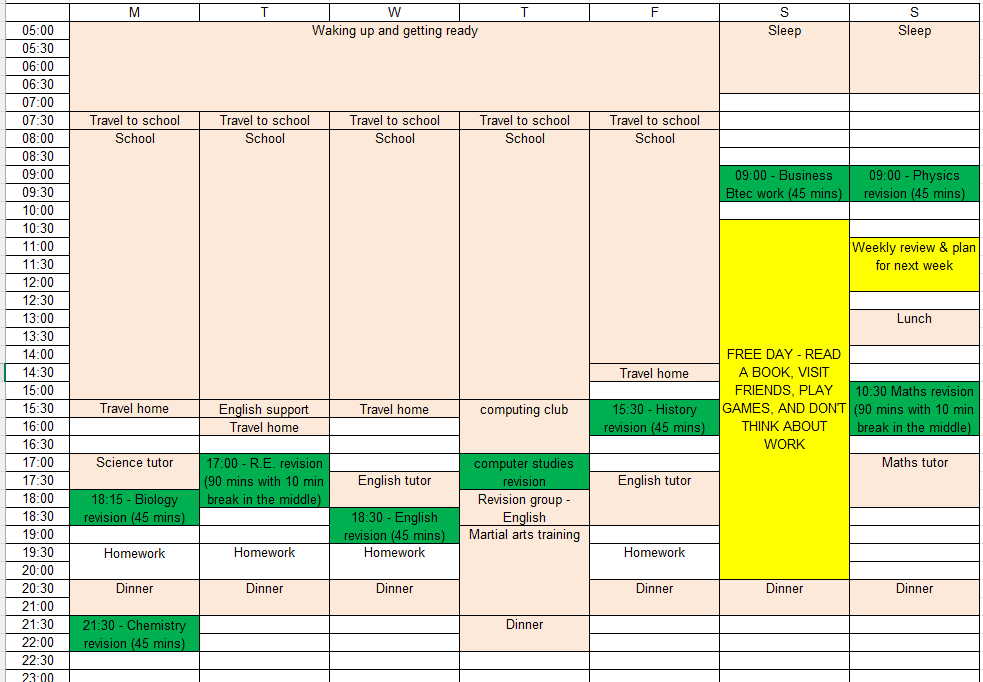
The best place to start is with a default diary. Set up a template of a weekly calendar (if you already use a weekly calendar online or in a diary you can use this, but you’ll need to have enough room to add detail). Fill into this calendar the weekly commitments you already have. This is for an average week, so don’t worry too much about ad hoc events.
Remember to add in time you give to:
School
Travel
Sleep
Mealtimes
Extracurricular activities
Then you can fit in your revision schedule around the default diary, being mindful of the times when you have energy, the times when you are able to work well, and the times when you will need rest. For example, if you have a sports club and after school study on Monday night, will you be getting up early to study physics on Tuesday? Be kind to future you and you will be more likely to stick to the plan.
Example revision schedule
ADHD and revision schedules
Students with ADHD often find it much harder to make and stick to these revision schedules. They may struggle to sleep, and it will be difficult to switch focus from one activity to the next. It is much better to focus on one task per day, and allow time for plenty of rest before bedtime.
Design a diary for holiday studies too, but be kind to yourself!
What comes next?
Everything becomes much less daunting with a plan, and if you’re able to follow through these steps with your child they should start to feel more in control of their workload. You can also get a copy of our day by day planner from Amazon to take you through these steps.
The systems in our brain that are meant to protect us from life-threatening danger (hungry lions, Jaws) can also keep us mentally ‘stuck’ and make much less life-threatening things very difficult (revision, speaking up in class).
It is unbelievably annoying, but it isn’t your fault, and recognising that is an important first step because 90% of that ‘noise’ in your brain is unjustified self-criticism. The brain bots try to prevent you from doing new, challenging things because they feel like they might present a danger, so they just keep firing off these STOP messages to keep you ‘stuck’ where it seems safer. And while it probably is safer to stay in that stuck state at the moment, it makes for a much more boring and less satisfying life.
It’s the same reason I don’t go into a gym, and why I never used to ask my teachers for help. It means reaching out and drawing attention to the areas you feel vulnerable, and the anxious brain says, ‘No thank you, stay at home please’. That is its default, so you have to arm yourself with lots of counter-messages to help keep it quiet.
Start a list of your wins.
Each time you do something that feels like a challenge, or that you’re proud of, write it down somewhere. It really doesn’t have to be major. I note a win when I go to the hairdresser, as I hate going to the hairdresser. I’ve been cutting my own hair for years over having a stranger washing and brushing my hair. That’s out of my comfort zone, and something else will be your challenge to face.
Anything can go on this list, and it will soon stack up. You’ll have a nice list of the times you thought you couldn’t do something, and surprised yourself, to show your anxious brain what you’re capable of. When you’re facing a new challenge and you hear the brain bots shutting it down, remind them that you can do this.
Ask for feedback.
You are definitely your own worst critic. Again, that isn’t your fault but it is in your control. I challenge you to seek feedback from the people who know you, and ask them to choose three words to describe you. I did this recently, and the results were incredible. I wouldn’t have picked the words I was given, but there were definite themes in the answers that helped me to identify my strengths.
I’ll bet lots of people will be willing to share that with you too, and you’ll be able to see how others see you. Then you can take a note of your strengths and use them when you face new challenges. Playing to your strengths and asking for help with everything else makes you much more likely to succeed.
Make it a habit to notice your gratitudes.
Every morning I write down 10 things I’m grateful for at that moment. A lot of the time it’s my morning coffee, or the animals, or even the fact that I got a good sleep the night before. Anything that has made you feel good can go on the list, and it helps your brain to start adopting a more positive attitude.
These things aren’t about you, but will also help you to notice the things that you’ve provided for yourself, and to keep the brain bots away from negativity. This really helps when you find yourself feeling ‘nothing ever goes right’, and you’ve got a list of all of the things that made you happy to counter that.
When the overwhelm is related to the amount of work you have to do, organising is the answer. But be warned – it gets a little worse before it gets better.
You need a clear picture of everything that’s on your plate, so start with a full brain dump. It might not feel good to see everything on one page, but I promise it’ll be worth it. Write everything you’re thinking about, worrying over, spending time on, onto a big sheet of paper (or an online document) and then work through this process with each of them.
If you think of more things as you go, you can add them to the list to follow the process rather than getting distracted.
Let it go
Are there things on here that are outside of your control? They might well be things that could have an impact on your life in the future (like who will win the next election, or will we catch flu), but there’s nothing you can do about them or in response to them at the moment, so they aren’t really your concern. They can be forgotten straight away, and you should take a moment to enjoy striking them off the list.
This is easier said than done, and sometimes it takes a little reset to get them off your mind. Change your environment, change your focus, or even take a cold shower. Give yourself something else to occupy your mind until it feels better.
You’re left with things that are inside your control only then. These are the steps I then take with my worries.
Action plan steps
Define the problem e.g. I have too many things to do and feel like I’m not in control. Important things aren’t happening and it is building up.
Think of as many solutions as possible no matter how silly they may seem e.g. delegate/drop some responsibilities, get help with something(s), extend deadlines, don’t sleep for a week (don’t do that one)
Consider the pros and cons of each solution. Do the benefits outweigh the consequences?
Choose a solution to try.
Plan how you are going to implement the chosen solution. Be specific about the action steps, and when. For help with setting these steps check out https://greentutors.co.uk/goal-setting/.
Review how it went. Were there any problems? Was it the right solution to choose? What did you learn?
It might still be a lot, but you’ll feel more in control. And you’ll be able to see where you need to ask for help, and who you can ask.If you find you’re regularly overwhelmed with GCSE prep, I have something that you will love. The Turn GCSE Stress into Exam Success Planner is an all inclusive planner and study companion for GCSE students to take control of their studies and reduce any associated stress with positive habits and a plan of action. You can be the first to get your hands on one with a special offer on the waitlist at subscribepage.io/TS2Splanner.














Recent Comments