As we approach the exam season, I am deeply reminded of how the process impacts the entire family. This year, I’ve had a clear insight into the family dynamics, watching my niece, Caitlyn, prepare for her exams. She’s working hard for the grades she needs to achieve her goal of becoming a vet.
I imagine this is a familiar scenario for any family heading towards exams. It isn’t just the teenager who is focused on them, but they are the ones who ultimately have to sit them. For the rest of the family, the anxiety often stems from a lack of power over the outcome
The Trap of Spending Money
This anxiety often manifests as spending money. When I start working with students, I’m often presented with pristine revision guides they’ve accumulated but not used, or they confess they’ve signed up to multiple online study sites and forgotten the login details.
The reality is, having all the right equipment is not the same as having a plan. It’s a lot like my own home gym. I have wonderful equipment and plenty of experience, but if I’m left to my own devices, I often tell myself, “I must use this, but not right now,” for months on repeat.
We cannot reasonably expect our teenagers, with all the pressure and hope riding on their exams, to be any better at holding themselves consistently accountable. They just won’t.
What Students Really Need
After 15 years of supporting students through this process, I know exactly what to expect and how to prepare. The most powerful tools I can provide are accountability, support, and bite-sized deadlines.
Just as my own exercise journey changes when I have a trainer in my corner, the students I work with thrive when they have structured guidance. The satisfaction of turning overwhelming stress into a clear, actionable plan never gets old.
This kind of planned support is vital because we need to manage stress effectively. A little stress is motivational and can drive students forward. However, too much stress leads to overwhelm, shutdown, reduced functioning, and a lower immune system. My goal is to keep them motivated and prevent them from hitting that peak-stress final hurdle without the energy to clear it.
Get the Study Success Plan You Need—For Free
You don’t need another pricey revision guide or a forgotten subscription. You need a simple, effective plan and the tools to support your child without adding to their burden.
I want to put my 15 years of experience into your hands. That’s why I created the Study Success Programme. This is a free programme designed to:
Teach students the essential study skills they need for exams.
Share with parents like you exactly how you can best support your child through the process.
Stop feeling powerless over the outcome. Sign up for the free Study Success Programme today, and let’s work together to turn overwhelm into a clear, confident path to the 2027 exams.
In today’s fast-paced world, efficiency is key. When it comes to learning, spending endless hours revising can be a drain on both time and productivity. But what if there was a way to master the art of efficient learning, allowing you to spend less time revising while still boosting your productivity? Well, you’re in luck. In this article, we will explore proven strategies and techniques that can help you optimize your learning process.
Whether you’re a student preparing for exams, a professional looking to upskill, or simply someone seeking to expand your knowledge base, efficient learning is essential. By implementing the right methods, you can streamline your study sessions and retain information more effectively. We’ll delve into the concept of active learning, where you engage with the material rather than passively absorbing it, as well as explore the importance of setting clear goals and utilizing effective study techniques.
Get ready to revolutionize your approach to learning. Say goodbye to endless hours of mindless revision and hello to a more efficient and productive learning experience. Let’s dive in and discover how you can master the art of efficient learning.
The Importance of Efficient Learning
Whether you’re a student preparing for exams, a professional looking to upskill, or simply someone seeking to expand your knowledge base, efficient learning is essential. By implementing the right methods, you can streamline your study sessions and retain information more effectively.
Common Challenges in Traditional Learning Methods
Traditional learning methods often involve passive reading and memorization, which can be time-consuming and yield limited results. Many individuals struggle with information overload and find it difficult to retain what they’ve learned. Additionally, the pressure to perform well in exams or meet work-related deadlines can add unnecessary stress to the learning process.
Understanding Effective Learning Techniques
To become an efficient learner, it’s crucial to understand and implement effective learning techniques. One such technique is active learning. Instead of passively absorbing information, active learning requires you to engage with the material. This can include activities such as problem-solving, group discussions, and practical applications of knowledge. By actively participating in the learning process, you enhance your understanding and retention of the subject matter.
Time Management for Efficient Learning
Time management plays a pivotal role in efficient learning. By effectively managing your time, you can allocate dedicated study periods and avoid procrastination. Start by creating a schedule that outlines specific study times and breaks. Set realistic goals for each session and prioritize tasks based on their importance and deadlines. Remember to incorporate regular breaks to rest and recharge your mind.
Creating a Focused Study Environment
A conducive study environment is essential for efficient learning. Eliminate distractions by finding a quiet space where you can focus without interruptions. Ensure your study area is well-lit and organized, with all necessary materials within reach. Consider using noise-canceling headphones or playing ambient background music to enhance concentration. Additionally, keep your study space clutter-free to minimize distractions and promote clarity of thought.
Utilizing Technology for Efficient Learning
In today’s digital age, technology offers a myriad of tools and resources to aid in efficient learning. Leverage digital platforms such as online courses, educational apps, and virtual study groups to supplement your learning. These tools provide convenience, flexibility, and access to a wealth of information at your fingertips. Explore platforms that align with your learning style and goals, and embrace the benefits of technology to enhance your learning experience.
Effective Note-Taking Strategies
Note-taking is an effective learning strategy that helps consolidate and reinforce information. Instead of mindlessly transcribing everything, adopt a more strategic approach. Focus on capturing key concepts, main ideas, and supporting details. Use techniques such as summarizing, paraphrasing, and visual aids to organize and structure your notes. Experiment with different note-taking methods such as Cornell notes, mind maps, or the SQ3R method to find what works best for you.
Active Learning Techniques
Active learning techniques promote engagement and deep understanding of the material. Incorporate activities such as problem-solving exercises, discussions, and teaching others. Utilize resources such as flashcards, quizzes, and interactive online platforms to interact with the content. Actively seeking opportunities to apply your knowledge in real-life scenarios reinforces learning and improves retention.
Using Spaced Repetition for Long-Term Retention
Spaced repetition is a powerful technique for long-term retention of information. Instead of cramming all your studying into one session, space out your review sessions over time. The concept is based on the idea that revisiting information at spaced intervals strengthens memory retention. Use flashcards, digital apps, or handwritten summaries to review previously learned material. Gradually increase the time intervals between each review session to reinforce your understanding and promote long-term retention.
Conclusion: Implementing Efficient Learning Strategies for Success
Mastering the art of efficient learning is a game-changer. By optimizing your study sessions, implementing active learning techniques, and utilizing technology and effective note-taking strategies, you can spend less time revising and boost your productivity. Remember to prioritize time management, create a focused study environment, and leverage the power of spaced repetition for long-term retention.
With these strategies in your arsenal, you’ll be well-equipped to tackle any learning challenge that comes your way. Embrace the power of efficient learning and unlock your full potential. Say goodbye to endless hours of mindless revision and hello to a more efficient and productive learning experience. Start implementing these strategies today and watch your learning journey transform. Happy learning!
Without having sat GCSEs before, it is difficult for students to know what ‘prepared’ looks like. As time ticks on, the pressure increases, and the best way to reduce it is to take positive action. So here are my tips for some things you can do today and going forward to feel more prepared for GCSEs.
Sleep is one of the most important elements of preparing for exams, but it is so often unappreciated. It is very likely you’re not getting as much sleep as you think you are. I thought I was getting 7 hours of sleep per night until I got a FitBit. Actually tracking my sleep told me it was actually 5 hours.
You don’t have to get a sleep tracker (although data = knowledge = power) but monitor how tired you feel when you wake up. Some of that may be dehydration, and some of it may be due to not getting enough sleep. Keep a drink of water beside your bed and sip from it whenever you wake up. If you feel tired when you wake up and the drink is empty, you’re probably not getting enough sleep.
Remember that teenagers need more sleep than their parents. If you’re all getting up at a similar time, children should go to sleep before their parents. And it doesn’t help to sleep in at the weekend to make up the hours. Consistency is key for effective sleep. Friday lessons should not need to be spent dozing on your pencil case.
While you can usually borrow anything you need to in the exam hall, it is always worth preparing your pencil case ahead of time.
These are the things you’ll need for your exam series:
A clear pencil case
A maths set with a set of metal compasses and a protractor
A good scientific calculator
Pens that are comfortable to write with
Mechanical pencils – no one wants to have a blunt pencil in an exam!
You can purchase all of these items for a low cost at the links below if you don’t already have them but do check what you have first.
I may earn a small amount of commission from purchases you make through links on this site, at no additional cost to you. Your purchases will remain anonymous.
When I talk students through their weekly timetable, one of the questions I ask them is “how much homework do you have each day?”. Would you have an answer to this question, or is it just ‘lots’? I know how easily work can creep up before we realise how much of our days, weeks, and months we are giving to them. Homeworks is important, but should be time-bound in order to make sure there is time each week for work, rest, and play. So how much homework should students be doing in year 11?
How much homework should I be doing in year 11?
Set goals for your homework
You of course want to do well, and are obviously a good student who doesn’t want to disagree with the teachers. But putting unnecessary pressure on yourself through an already stressful year is only going to make it harder to reach your goals.
If you haven’t set specific goals for yourself yet, I’d recommend you do. It helps you to focus on the things that give you the best chance of success, and therefore make the best use of your limited time this year.
Students don’t just get work from one direction. There are several demands on their time. This is how I tell my students with a homework and revision schedule to prioritise their study time.
First do the homework on the timetable.
Then do the revision on your schedule.
And only then do any additional homework you have time for.
Every school approaches homework slightly differently but generally there is a schedule to the way homework is set, so you shouldn’t have work for every subject on every day. And some pieces of work are more than can be completed in an evening (like coursework) and would be spread out over a longer time period.
Make a homework agreement
Some schools have an agreement on how much homework students should be doing in year 11. Students with additional needs may have a specific arrangement on this. If you don’t have one, I would encourage you to aim for one. Ideally homework should be no more than 1-2 hours per evening, and in year 11 it is likely that a significant part of that would come under ‘revision’ anyway.
If this doesn’t match up with the work you are being set, speak to your teacher, form tutor, or head of year to see how they can help you with it. The work is set to help you rather than to burn you out, and in most cases they will be happy to offer advice and support.
If you encounter any challenges, share this with your parents/guardian. The teacher can speak to them to confirm the amount of time you’ve spent doing homework. Any pushback is likely to be based on the need to encourage students to work. If you can show that is what you are doing, that should be all that is required.
Get a homework study buddy
If you find homework challenging, try working with someone else in your class. This can often make the work less daunting, and actually more beneficial. You could use break and form time to work together, or perhaps work together after school.
I often do this for the work I find most challenging even now. It helps me to overcome any mind blocks I encounter. It also adds some accountability if you’ve arranged a time to work together. You’re less likely to both lose motivation at the same time. You get the work done faster and have more fun doing it.
Make time for rest and play
I think teachers sometimes forget just how many plates you’re balancing in year 11. They’re balancing a great deal themselves, and it is very easy to forget the challenges of being a teenager. If you are finding you need a break, you can’t focus any more, or you’re feeling overwhelmed, it’s time to step away from the books and do something for your wellbeing.
Rest time can be sleep, reading, spending time with family and friends, meditation, walking, stretching, listening to music, or anything that recharges you.
Play time can be sports, social events, gaming, crafts, or anything that inspires you and makes you feel joy.
Making time for these even when you have lots of work to do is actually beneficial. They help you to recharge. Our minds and bodies need a balance and none of us can work all of the time. Check out this blog for more details on why.
If you would like to make better use of the days, weeks, and months leading up to your exams, you can get a copy of The Ultimate Guide to Exam Preparation completely free at subscribepage.io/greentutors. And if you’d like help implementing a schedule that works, you can sign up for a revision workshop with me at https://calendly.com/greentutors/revision-masterclass.
I’m always being forwarded GCSE maths hacks videos (like this one) claiming to provide a shortcut to maths success with some neat trick. While they’re a lot of fun to watch and often highlight a neat numerical pattern, they’re no substitute for actual understanding of the subject material and problem solving skills.
GCSE Maths Hacks: Anti-Learning
What works for one doesn’t work for all
Often these GCSE maths hacks will show you a trick that works for a particular question, or a particular type of question. They might not even include any explanation of why they work. So how do we know this particular GCSE maths hack will work for the problem we’re trying to solve, even if we remember the hack?
The answer is that we don’t, unless we work out why the hack works in the way it does, which means working out the theory being applied in the question. And if we understand the theory, do we need a hack, or just practise applying our problem solving skills to this theory?
Difficult to memorise
These hacks only work if we remember them, which means committing a series of GCSE maths hacks to memory before your exam. While that may be possible, it’s actually harder than learning the material on the curriculum. There are endless GCSE maths hacks and it would require an extensive library to cover the entire curriculum. Alternatively we can select a few trusted hacks and hope that those are the ones that answer the questions on our paper. But what are the chances of being that lucky?
It just doesn’t make sense to put the time and energy into memorising hacks instead of putting it into learning the curriculum and practising applying it to exam style questions.
As I said, in order to correctly understand GCSE maths hacks and when you apply them, we need to understand the maths theory that makes them work. Which would mean that we don’t really need the hack, right?
This is potentially the one bonus I see in GCSE maths hacks videos. We can work backwards from the solution demonstrated in the hack to the theory that makes it work. It’s a good way to demonstrate mathematical patterns. But having analysed it in this way, we not only don’t need to remember the hack but will have gone one better by understanding the theory.
The correct application of mathematical theory will allow us to solve whatever question we are presented with for GCSE maths, with one additional skill.
Develop problem solving skills
It is important to practise solving a variety of problems in preparing for your exams, and as a valuable life skill. The mathematical problems we are presented with in exam preparation are a workout for the mind, and develop our ability to solve problems outside of maths.
In order to develop our problem solving skills we need to work with a variety of different questions, rather than see if we can find a shortcut that doesn’t require any understanding to apply. That misses the entire benefit of an education in mathematics.
Practice makes perfect
It is really important to keep practising these skills to develop our mathematical understanding and problem solving skills. This practice does not come through using GCSE maths hacks to find answers. It comes through understanding the problem and working out a route to the correct answer. Practice, practice, and more practice is how we get really good at this. Most of us study maths for ten years before we sit our GCSEs. Nothing about that decade of practice suggests that success comes overnight.
You can find lots of practice questions by topic at Maths Made Easy.
How many times has a teacher told you to check your work? It isn’t to do their job for them, but because we often make mistakes that we can correct ourselves if we check our answers by checking our method, or using an inverse operation to work backwards. How can we do that when we’ve used a GCSE maths hack? We can’t check or reverse a method without first understanding it.
So while I encourage you to keep sharing any interesting maths videos you find, resist the temptation to memorise this hocus pocus and instead spend time understanding the logic behind the problem, so that you can solve any type of question that comes your way.
One of the main reasons that students put off studying is that they don’t know where to start. Building tasks into a schedule and setting up positive habits for your wellbeing can take the mental energy out of the equation, so building a revision schedule for wellbeing becomes a process to follow from one day to the next. I regularly take students through this process in my Revision Workshop, and I’ve summarised the process here.
How much time do you have each week?
The first step is to work out how much free time you actually have each week. There are 168 hours in every week, but you split them between:
School
Travel
Sleep
Mealtimes
Extracurricular activities
How much time do you need to take from your 168 hours for each of those?
What is left over? Can you allocate one third of that remaining time to study? (Splitting it between work, rest, and play).
I would encourage you not to scrimp on sleep. Teenagers generally need around 9 hours of sleep each night, which is more than their parents, as they’re still growing and developing their brains. This is very important for processing everything they’ve learned in the day so still counts towards the revision plan!
What are you studying?
This is a nice and simple task. Make a list of the subjects you are studying.
For most students, this will look like:
Maths (Foundation, Higher, Functional Skills)
English literature
English language
Biology (Triple / Combined)
Chemistry (Triple / Combined)
Physics (Triple / Combined)
Humanities (History / Geography / R.E.)
Modern foreign languages (French / German / Spanish / Italian)
It would be helpful here to also note the exam board and specification. If you’re not sure, you should be able to get this from your teacher or tutor, or post it in the Facebook group and I’d be happy to help.
Take a look at where you would like to be for each of these and how far you are from achieving that at the moment. This will help you to prioritise your time through the schedule to those that need the biggest push.
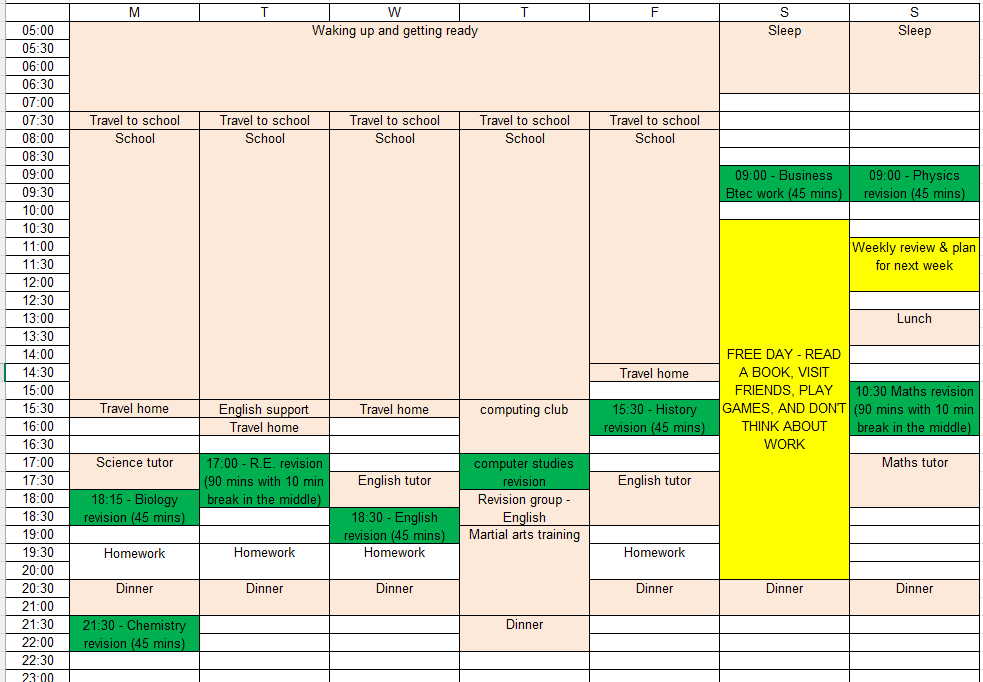
Now that you know how much time you have each week to study, and where you need to focus your attention, you can start to build your weekly revision schedule.
The best place to start is with a default diary. Set up a template of a weekly calendar (if you already use a weekly calendar online or in a diary you can use this, but you’ll need to have enough room to add detail). Fill into this calendar the weekly commitments you already have. This is for an average week, so don’t worry too much about ad hoc events.
Remember to add in time you give to:
School
Travel
Sleep
Mealtimes
Extracurricular activities
Then you can fit in your revision schedule around the default diary, being mindful of the times when you have energy, the times when you are able to work well, and the times when you will need rest. For example, if you have a sports club and after school study on Monday night, will you be getting up early to study physics on Tuesday? Be kind to future you and you will be more likely to stick to the plan.
Example revision schedule
ADHD and revision schedules
Students with ADHD often find it much harder to make and stick to these revision schedules. They may struggle to sleep, and it will be difficult to switch focus from one activity to the next. It is much better to focus on one task per day, and allow time for plenty of rest before bedtime.
Design a diary for holiday studies too, but be kind to yourself!
What comes next?
Everything becomes much less daunting with a plan, and if you’re able to follow through these steps with your child they should start to feel more in control of their workload. You can also get a copy of our day by day planner from Amazon to take you through these steps.
We use technologies like cookies to store and/or access device information. We do this to improve browsing experience and to show (non-) personalized ads. Consenting to these technologies will allow us to process data such as browsing behavior or unique IDs on this site. Not consenting or withdrawing consent, may adversely affect certain features and functions.
Functional
Always active
The technical storage or access is strictly necessary for the legitimate purpose of enabling the use of a specific service explicitly requested by the subscriber or user, or for the sole purpose of carrying out the transmission of a communication over an electronic communications network.
Preferences
The technical storage or access is necessary for the legitimate purpose of storing preferences that are not requested by the subscriber or user.
Statistics
The technical storage or access that is used exclusively for statistical purposes.The technical storage or access that is used exclusively for anonymous statistical purposes. Without a subpoena, voluntary compliance on the part of your Internet Service Provider, or additional records from a third party, information stored or retrieved for this purpose alone cannot usually be used to identify you.
Marketing
The technical storage or access is required to create user profiles to send advertising, or to track the user on a website or across several websites for similar marketing purposes.











Recent Comments