You may be considering hiring a tutor, but not sure what to expect. You might have experienced hard sales tactics in the past, or regretted sharing your contact details by the fifth ‘Just checking’ message. I want to put your mind at ease today and tell you exactly what happens when a potential client gets in touch with me at Green Tutors.
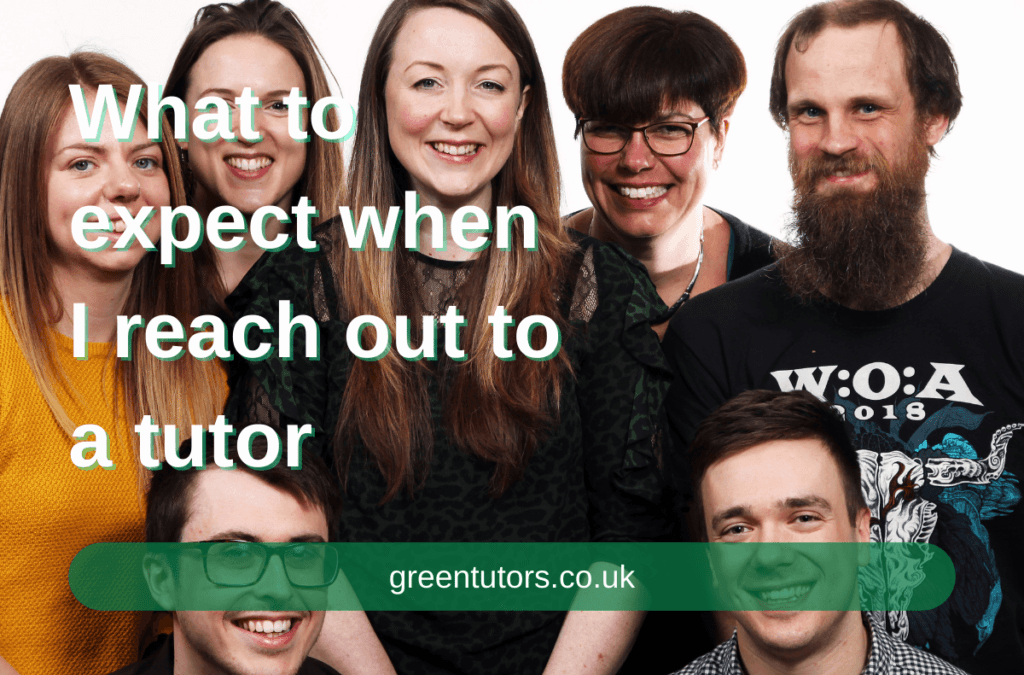
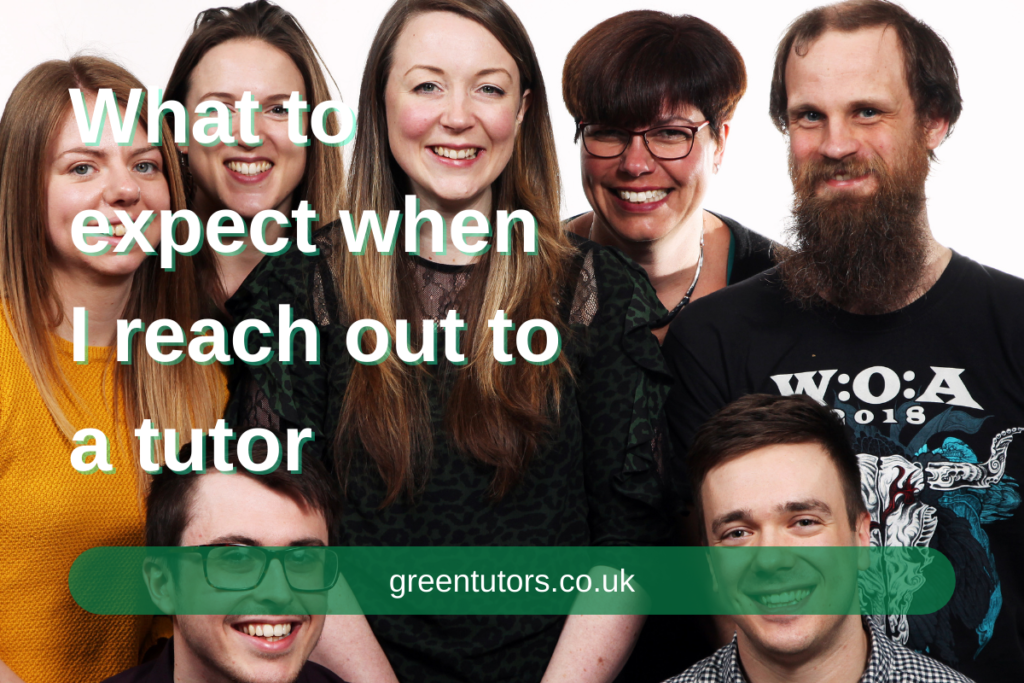
The tutor team April 2019
These are some of the questions I am frequently asked when people contact me.
What information do you need?
Ultimately, I just need to be able to contact you when you request a tutor. Within a quick phone call or text conversation, I can identify the support you need, and whether it is something I can provide.
While every student is different, and the benefit of hiring a tutor is that tuition can be very personalised, there are a few common threads that our tuition tends to follow.
I will ask the age of your child, what they’re currently studying (qualification and level, i.e. GCSE maths and they’re in year 10), and identify what their particular goals and challenges are.
This will help me to match them to a tutor and share some advice, but their tutor will work with them in more detail and make sure they receive the targeted support they need.
When do I have to pay?
You won’t have to pay a penny until you’ve agreed on an ongoing schedule after hiring a tutor. Lessons are billed monthly in advance, so you will receive a bill for the remainder of the current month, due a couple of days before the first scheduled lesson happens.
Going forward, you’ll receive monthly invoices around the middle of the month, giving you at least a week to pay (usually two).
When you’re hiring a tutor for a regular lesson, the bill should be the same each month, and you can set it up on a Direct Debit so you don’t have to think about it.
If you want to change your schedule, pause the lessons, or increase them as exams approach, you can do that whenever you like, with a minimum of 48 hours’ notice. There is no minimum requirement for bookings.
What happens in the lessons?
There is no set approach, as the tutors will customise the lesson to the student and their goals.
If the student needs to build confidence, we’ll work on demonstrating their abilities, getting some ‘quick wins’ to show them what they’re capable of, and spend more time on any identified challenging areas as they come up. You can read more about this in our blog How can students get more confident before their exams.
If the student is preparing for an exam, we’ll work through exam questions with them, share the way that mark schemes are applied, and assist them in finding ways to put their knowledge onto paper. We’ll also share time management skills to help prevent overwhelm.
For anxious students, we’ll work through an anxiety ladder with them and help them to improve their resilience. We’ll share positive habits that will improve their well-being and help them to deal with future challenges. Cai Graham share’s some great advice on managing stress and anxiety.
Ultimately, we’re trying to make ourselves redundant. Successful hiring of a tutor ends with a student who can learn and grow independently so that they can go on to the next step of their academic career with confidence and a study ‘toolkit’.
What happens if my child doesn’t get along with the tutor?
I make sure that all of the tutors I hire are friendly and approachable, and know how to build relationships with their students.
That being said, it is important for the student to get along with their tutor, as we’re encouraging them to step out of their comfort zone and be vulnerable.
If you hire a tutor and then feel like your child is not getting along with them, I encourage you to get in touch and let me know. We’re very happy to receive your feedback, and we’re able to match you to a new tutor very quickly. We don’t take it personally.
Your tutor will also let you know if we feel like there is a challenging relationship, and give recommendations, as we want you to get the most from your investment. We know well that not every child comes easily to tutoring, and we’re happy to work with you to identify and improve any roadblocks. We want our students to enjoy learning.
Do you provide the support I need?
We provide online tuition for STEM subjects (maths, science, computer science, engineering) for 11-18-year-olds and adult learners.
I have been operating in this area since 2011, and have a wealth of experience in this area.
But I also have a wide network in the tutoring community, and I am always able to recommend someone if what you need doesn’t match what we offer.
For primary tuition I often refer students to Portia Smith.
What support will my child get?
Alongside regular tuition, we provide each student with a library of resources to work with in a Google Drive.
We send everyone a graphics tablet after their first session so that they can work directly with their tutor online. It removes the need to print massive exam bundles and means their work is saved online.
We provide a free revision masterclass to all clients so that they can make the most of their time with the tutor by also building in good habits. They’ll leave with a revision schedule that works for them, and includes time for work, rest, and play.
They’ll learn valuable study skills that they will be able to take with them through their entire academic career, from our team of experienced academic tutors who know well how to make the most of their study time.
—
We’d love to support your child with their study goals. Submit your details at https://greentutors.co.uk/request-for-tuition/ for a no-obligation introductory appointment with a tutor.
The systems in our brain that are meant to protect us from life-threatening danger (hungry lions, Jaws) can also keep us mentally ‘stuck’ and make much less life-threatening things very difficult (revision, speaking up in class).
It is unbelievably annoying, but it isn’t your fault, and recognising that is an important first step because 90% of that ‘noise’ in your brain is unjustified self-criticism. The brain bots try to prevent you from doing new, challenging things because they feel like they might present a danger, so they just keep firing off these STOP messages to keep you ‘stuck’ where it seems safer. And while it probably is safer to stay in that stuck state at the moment, it makes for a much more boring and less satisfying life.
It’s the same reason I don’t go into a gym, and why I never used to ask my teachers for help. It means reaching out and drawing attention to the areas you feel vulnerable, and the anxious brain says, ‘No thank you, stay at home please’. That is its default, so you have to arm yourself with lots of counter-messages to help keep it quiet.
Start a list of your wins.
Each time you do something that feels like a challenge, or that you’re proud of, write it down somewhere. It really doesn’t have to be major. I note a win when I go to the hairdresser, as I hate going to the hairdresser. I’ve been cutting my own hair for years over having a stranger washing and brushing my hair. That’s out of my comfort zone, and something else will be your challenge to face.
Anything can go on this list, and it will soon stack up. You’ll have a nice list of the times you thought you couldn’t do something, and surprised yourself, to show your anxious brain what you’re capable of. When you’re facing a new challenge and you hear the brain bots shutting it down, remind them that you can do this.
Ask for feedback.
You are definitely your own worst critic. Again, that isn’t your fault but it is in your control. I challenge you to seek feedback from the people who know you, and ask them to choose three words to describe you. I did this recently, and the results were incredible. I wouldn’t have picked the words I was given, but there were definite themes in the answers that helped me to identify my strengths.
I’ll bet lots of people will be willing to share that with you too, and you’ll be able to see how others see you. Then you can take a note of your strengths and use them when you face new challenges. Playing to your strengths and asking for help with everything else makes you much more likely to succeed.
Make it a habit to notice your gratitudes.
Every morning I write down 10 things I’m grateful for at that moment. A lot of the time it’s my morning coffee, or the animals, or even the fact that I got a good sleep the night before. Anything that has made you feel good can go on the list, and it helps your brain to start adopting a more positive attitude.
These things aren’t about you, but will also help you to notice the things that you’ve provided for yourself, and to keep the brain bots away from negativity. This really helps when you find yourself feeling ‘nothing ever goes right’, and you’ve got a list of all of the things that made you happy to counter that.
When the overwhelm is related to the amount of work you have to do, organising is the answer. But be warned – it gets a little worse before it gets better.
You need a clear picture of everything that’s on your plate, so start with a full brain dump. It might not feel good to see everything on one page, but I promise it’ll be worth it. Write everything you’re thinking about, worrying over, spending time on, onto a big sheet of paper (or an online document) and then work through this process with each of them.
If you think of more things as you go, you can add them to the list to follow the process rather than getting distracted.
Let it go
Are there things on here that are outside of your control? They might well be things that could have an impact on your life in the future (like who will win the next election, or will we catch flu), but there’s nothing you can do about them or in response to them at the moment, so they aren’t really your concern. They can be forgotten straight away, and you should take a moment to enjoy striking them off the list.
This is easier said than done, and sometimes it takes a little reset to get them off your mind. Change your environment, change your focus, or even take a cold shower. Give yourself something else to occupy your mind until it feels better.
You’re left with things that are inside your control only then. These are the steps I then take with my worries.
Action plan steps
Define the problem e.g. I have too many things to do and feel like I’m not in control. Important things aren’t happening and it is building up.
Think of as many solutions as possible no matter how silly they may seem e.g. delegate/drop some responsibilities, get help with something(s), extend deadlines, don’t sleep for a week (don’t do that one)
Consider the pros and cons of each solution. Do the benefits outweigh the consequences?
Choose a solution to try.
Plan how you are going to implement the chosen solution. Be specific about the action steps, and when. For help with setting these steps check out https://greentutors.co.uk/goal-setting/.
Review how it went. Were there any problems? Was it the right solution to choose? What did you learn?
It might still be a lot, but you’ll feel more in control. And you’ll be able to see where you need to ask for help, and who you can ask.If you find you’re regularly overwhelmed with GCSE prep, I have something that you will love. The Turn GCSE Stress into Exam Success Planner is an all inclusive planner and study companion for GCSE students to take control of their studies and reduce any associated stress with positive habits and a plan of action. You can be the first to get your hands on one with a special offer on the waitlist at subscribepage.io/TS2Splanner.
As you know, we’re all about finding great role models in STEM careers to inspire our students. Elan is no exception to that!
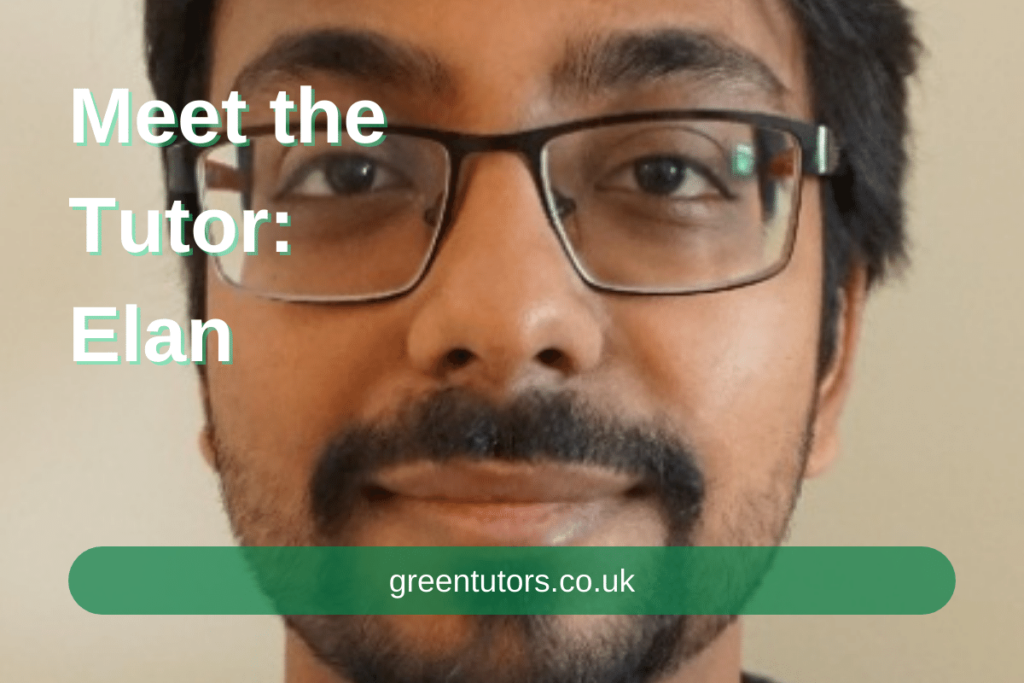
Another fantastic member of the tutor team, chemical engineering student Elan is tutoring maths, chemistry, and physics for GCSE and A level. He’s fully booked for 2022 exams but you can get on the waitlist for a September 2022 start.
I went through a series of different career choice options, but ultimately chose chemistry because of trying to understand more of the world around us on the atomic scale and using that knowledge to inspire a greener future.
Elan Mistry
Having already gained a BSc & ARCS in Chemistry, and MRes in Nanomaterials (achieving a Distinction), from Imperial College London, Elan is now a PhD Candidate in Chemical Engineering at UCL. He is researching the synthesis of ammonia through photo-electrochemistry. (Incidentally, socially conscious Imperial launched a free online course on Coronavirus that you can access here.) He was also awarded First Prize in a writing competition hosted by the IChemE London & South East Young Members’ Forum answering, ‘How is Chemical Engineering Addressing a Global Issue?’.
Elan is excited to help, inspire and reassure students to do well in their studies. He enjoys playing Squash and Badminton. He also enjoys baking. I’m excited to help him gain experience through tutoring to help students in their understanding and passion for STEM subjects.
Based in Finsbury Park, Elan will be primarily tutoring students online, through Zoom and/or Google Meet. Our students and tutors are all now very familiar with using these platforms for lessons, and it actually has provided several opportunities that don’t exist in face to face lessons. An article from the World Economic Forum shared data that “on average, students retain 25-60% more material when learning online compared to only 8-10% in a classroom”. We can be more ‘ad hoc’ with scheduling lessons, and the content covered. Having to work through online platforms may have initially seemed like a barrier, but it has now opened up additional opportunities for students to engage in their lessons, and create learning material ‘as they go’.
I asked Elan a few questions about his academic and career experience so far.
What did you study to get here?
A level Chemistry (Edexcel) A*
A level Further Mathematics (Edexcel) · A*
A level Mathematics (Edexcel) · A
A level Physics (OCR) · C (A at AS)
I received the Doug Peacock Memorial Award 2015 Certificate of Distinction for achieving the highest grade in Chemistry A Level out of 80 students at Kingsbury High School Sixth Form.
Is this what you always wanted to do?
I went through a series of different career choice options, but ultimately chose chemistry because of trying to understand more of the world around us on the atomic scale and using that knowledge to inspire a greener future.
What kind of student were you at school?
Focused, determined and well mannered
Did you have a tutor?
Yes I did! I found it extremely helpful to have a tutor to support my studies. I had a tutor during my GCSEs and A Levels and found that the 1-to-1 sessions were essential in enabling me to reach where I am today. The individual lesson provided me with the confidence to ask questions that I wasn’t comfortable with asking in school. The sessions also helped me pick out my weaknesses and overall strengthen my skills.
How did you decide what to study?
I wanted to study something in which I could make a difference. With chemistry, we can make materials to combat climate change and hopefully build a better future.
Have you made any mistakes along the way to your current career?
Too many to count! But it’s important to make mistakes! Mistakes are important tools to ensure you eventually arrive at the right answer or the right path. Learning from your mistakes let’s you grow and develop your skills.
I had some setbacks during my university studies which meant that I could not do an integrated masters degree. I finished with a BSc. In spite of this, I decided to take some time to study to improve my confidence in the topics and come back to complete an MRes in Nanomaterials with a Distinction.
What are your top three tips for GCSE students?
Don’t panic
Read the specification for your course
Start revising early
Great advice for our students in 2021! It’s never too early to build good study habits. You can read more revision tips in our ‘Study Tips’ blog series.
Elan is available weekday evenings and weekends for online lessons in maths, physics, and chemistry. Get in touch here to find out more and book a lesson.
Every school student has notes from their classes, but what those notes look like varies more than the UK Government advice on face masks.
Making study notes
Some students write down every word that the teacher says, in the hope that they’ll make sense of it later.
Others write down a title and then spend the rest of the lesson chewing the pen and staring out of the window.
Some of my teachers used to put study notes up on the board for us to copy down. Cue shouts of, “Miss, what does that say?”
It doesn’t inspire confidence that they actually understand what they’re writing down, or why they need that information.
And often when it comes to revision, the go-to plan is to make a new set of study notes on the entire course. I’ve seen students spend vast amounts of time colouring in headings, creating flowery borders, and choosing the perfect pastel highlighter combinations at this point, rather than spend the time on what’s important.
So it’s fair to say that every student knows that they need notes, but not necessarily how to take and to make notes that will help them.
Active Revision
I am always telling students that they have to use active revision methods for effective learning. But what does that mean?
Active revision is about actually processing the information through your brain in a conscious way so that you are moving more of it from your short-term memory to your long-term memory.
How can you do that?
Before you make your notes, you need to understand what you’re writing about. So I sometimes tell students to look at a video on a topic, or I’ll explain the key points to them, so we can have a discussion on it before they transfer it into a set of notes.
I can then review those notes to make sure they’ve captured all of the key points they’ll need, and explained them correctly. If they’re working alone, they can check the notes against the course specification.
That way, they’ve moved the information into their long-term memory at the same time as they’ve created a set of notes they can use before the exam to review the information and recall anything they might have forgotten in the meantime.
Look after your future-self
Future you will be delighted that you’ve made a great set of notes up-front. As soon as possible after learning a new topic is the best time to create that set of notes, while it is fresh in your mind.
Also, it means that you can create that bank of notes over the entire course, rather than the last-minute cramming period before the exams.
At that point, you’ll be experiencing heightened levels of stress and anxiety, perhaps having trouble sleeping, and feeling the pressure of deadlines. There are also lots of emotions around that time of year as students spend less time in school, and start saying goodbye to their friends. If you can take something out of the mix by getting started early, it’s a great idea to do that! Look after your future self with a little extra work now.
Highlight anything that’s missing
Following these good note-taking and review practices means that you will be able to spot anything that’s missing early on. I encourage students to check their notes against the specification to ensure they’ve covered all of the required content. If you can see that you’ve completed an entire topic but there’s a key element missing, you can reach out for help to fill that gap early on, rather than finding out later. Again, this will reduce the last-minute stress.
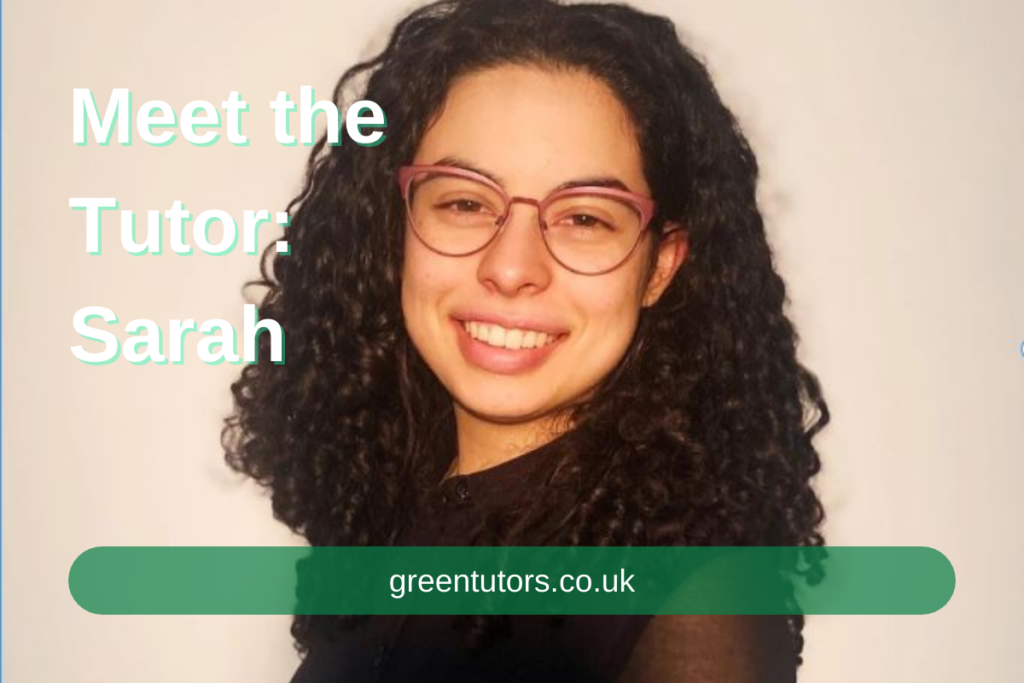
Sarah Patterson is a recent graduate from Imperial College, joining the Green Tutor’s team in 2020. We asked Sarah about her academic and career experience, and her career advice for students. When asked why she wanted to be a tutor, Sarah replied: “I want to help students achieve their academic goals and support them through their A-level and GCSE qualifications.”
Sarah’s an accomplished student herself with a passion for STEM, having achieved a First Class MSci Chemistry degree with a Year in Industry from Imperial College London. To become a better tutor and support her students, Sarah undertook the Qualified Tutor course and achieved the Level 3 Qualification. This course taught her about safeguarding for tutors, building effective tutoring relationships, the learning loop, and how to adapt tutoring for children with special educational needs and disabilities.
We asked Sarah about her pathway onto her STEM career, and her top tips for GCSE students right now.
What kind of student were you at school?
I was very studious, academically competitive but also loved socialising and spending time with friends.
Did you have a tutor?
No, I did not.
How did you decide what to study?
I decided to study chemistry as I thought it would give me a diverse skill set. This has indeed been the case; I have learned Python for programming, writing technical lab reports, and developed excellent time management skills through juggling lab work, studying, and extracurricular activities.
Have you made any mistakes along the way to your current career and do you have any career advice?
During the start of my time at University, I made the mistake of focusing too much on my studies. I should have gotten involved with the career centre earlier and applied for spring internships and first-year internships.
When I was applying for roles, I found interviews very challenging. I tried to learn as much as possible from these setbacks and practise with friends beforehand. Another set-back is lacking self-confidence which is something I try and help my students with.
What are your top three tips for GCSE students?
Go through exam board specifications/curriculum expectations
Practise past papers/exam style questions under exam conditions
Start revising early
We’re excited to welcome Sarah to the team to tutor Chemistry, Biology, and maths with us. Her experiences and career advice highlight the importance of having a view ‘beyond the books’ when studying. Having a mentor who has walked your path before you can help you to make the best use of your time, and ensure you don’t miss out on opportunities along the way.






Recent Comments