In our current climate, more and more of our interactions are taking place through the internet. And while these platforms have always existed, their rapid growth and uptake in new areas have identified potential problem areas. Parents ask themselves, is it safe for children to be working online?
We’ve all seen the news stories of Zoom-bombing incidents, online grooming gangs, phishing emails, etc. It’s enough to make you join with Fox Mulder and Trust No One.
Parents are (understandably) worried about the prospect of their children having access to the internet and in particular, social media. It gives them ready access to a world that is impossible to control. And I’m sure your own experiences have not always been positive. What proportion of the messages you receive are from people you don’t know? I’m sure we’ve all received some dubious unsolicited messages.
Most adults are savvy enough to identify messages with bad intentions, and hit the block and report options. But that understanding comes from experience, and experiencing this is what we’d like our children to avoid.
There are things that you can do to create a safety buffer for them, and I’d like to share some of these with you here. I’d love to hear from you about your own experiences too.
Online lessons
At some point this year, it is likely that your child has had some of their school resources provided to them online. This has been happening for many years, but again this year has become more widespread.
For this purpose, whatever platforms the schools use, they tend to provide each student with a school login, on their school domain. The student email addresses will have the same domain as the staff email address (the part following the @) to make them easy to identify. This means that their resources can only be accessed by accounts that are part of this domain, and accounts are only provided to students and staff. No one will be able to connect to these resources with a personal email account. This is protective both ways – only approved members are allowed in, and there are no links out.
Why is it important that there are no links out? If your child (or their teachers) have online accounts elsewhere with these same email addresses, it will be possible to find them from those details. Your child might not want their peers and school staff to be able to find them on other platforms, so it is better to use separate details. Additionally, most school staff don’t want their students to see their social media accounts, and certainly shouldn’t encourage the use of those platforms for communication. It is much better to keep them completely separate.
For the same reason, your child should never log in to social media accounts using their school login. Not only does it make that connection again, but it also shows which school they attend. That’s a potential opening for potential catfishing, or other unscrupulous messages. It would be easy to pretend to be a peer reaching out through a faceless platform.
Within Green Tutors, materials are shared with parents directly, and using our own domain, so that parents and students will know that they are talking to their DBS checked tutor.
Learning about online safety
There are so many places that you can go online to learn about keeping children safe online, and to teach your kids about internet safety too. Here are some of the best resources that answer the question, ‘Is it safe for children to be working online?’
This website is all about helping parents to keep their children safe online. There are guides to almost everything you might need to know for working safely online, downloadable checklists, conversation prompts, and also links to lots of great online resources for your child.
This site covers a high level overview of the many aspects of child safety online, as well as some tips on how to prevent, mitigate, and respond to any safety issues. Here are their top tips for video streaming.
Tips for video streaming
1. Talk to your child
Talk to them about what they’re doing online and how they can stay safe. Let them know they can come to you, or another adult they trust if they’re feeling worried or upset by anything they’ve seen online. They can also get support from Childline.
2. Explore apps and sites together
Explore what your child likes to do online together. This can help you to understand why they’re using certain livestreaming or video apps. You can use Net Aware, in partnership with O2, to help you.
3. Agree what’s appropriate together
Agree your own rules as a family when using apps, sites or games. You can use the O2 and NSPCC family agreement template to help get you started.
4. Check your settings
Check the technology your family uses and use privacy and location settings to keep your child safe. You can call your mobile and broadband provider to find out how to do this. Visit our parental controls page to find out more.
Net-Aware
If you’re worried about specific apps or threats online, you can look them up at https://www.net-aware.org.uk/ and find out more about them. Not only does this tell you how safe they are, but also how you can set them up to be as safe as possible, what they are used for, and you can sign up to their mailing list for updates.
It also won the Internet Matters Digital Safety award for the Best Product or Service for Parents.
Most teens are familiar with this site as a place for online revision. I use it with my own students, and even used it when I was preparing for my GCSEs. It’s very up to date, and I’d definitely recommend it. It is a completely one-way platform, so a totally safe way to learn.
It also has a course on eSafety aimed at 11-14 year olds at the link above.
This website is designed for children to access information themselves about the various issues they may face on and offline.
This can be a great approach if you’re concerned about them keeping problems from you, or being embarrassed to talk about things. Teens like to think their parents don’t know everything or understand their problems. I know well that mothers are psychic and know way more than they are told about their children’s lives.
It is certainly good to encourage them to talk to you first, and you can prompt them with a relaxed conversation. But it can be good to help them feel that they’re in control and learn their own coping mechanisms.
This is a fun resource designed to teach children about using the internet safely, but is presented in a fun gaming style. They have to pass ‘levels’ to progress through the game by answering internet safety questions. There’s even a bit of geometry in there for the maths fans.
CyberGhost provides a VPN for secure web browsing. Their privacy hub contains valuable articles on staying safe online, especially this article on how to keep children safe online.
You know your child the best, and you will know how smart they would be in working safely online, and coming to you if anything seems wrong.
This set of top tips to share with children from https://www.safetynetkids.org.uk/ is the best summary advice I’d share to get started with working safely online.
Don’t post any personal information online – like your address, email address or mobile number.
Think carefully before posting pictures or videos of yourself. Once you’ve put a picture of yourself online most people can see it and may be able to download it, it’s not just yours anymore.
Keep your privacy settings as high as possible
Never give out your passwords
Don’t befriend people you don’t know
Don’t meet up with people you’ve met online. Speak to your parent or carer about people suggesting you do
Remember that not everyone online is who they say they are
Think carefully about what you say before you post something online
Respect other people’s views, even if you don’t agree with someone else’s views doesn’t mean you need to be rude
If you see something online that makes you feel uncomfortable, unsafe or worried: leave the website, turn off your computer if you want to and tell a trusted adult immediately.
I hope this helps you to feel more comfortable about working online. When working with a company online, you should always be able to ask any questions you need to about how they improve and ensure the safety of your family, and at Green Tutors we’re happy to be able to put our clients at ease.
Do you struggle to recall things you know you’ve learned, and wish you knew how to improve your memory for exams?
Effective revision requires a lot of self-motivation, organisation, and good old-fashioned hard work. It means making a long-term commitment to study and putting the work in even when you don’t feel like it. Unfortunately, there are no shortcuts.
But sometimes it feels like it really isn’t worth it when you keep covering the same topics time and time again and none of it is sinking into your memory for exams.
In this article I’m sharing my top 10 tips to improve memory retention and recall, so that time spent on revision is as effective and rewarding as possible.
Don’t just read it
When we’re reading, the words pass through our head for long enough to string sentences together, and then pass straight back out again. What we retain might be a general picture in order to keep a story together, but not much more. It is very rare to read a text once and be able to quote it back afterwards, unless it was really meaningful to you.
What helps to move that information from short-term to long-term memory for exams is doing something more with it, which can be as simple as writing it down.
But that doesn’t mean copying it word for word – that takes very little brain work and so doesn’t retain the information. Turn it into bullet points, a table, a mind map, a list, etc that will stick in your memory for exams.
Make it meaningful in your memory for exams
While we don’t fully understand the way the mind works yet, we know it is capable of some astonishing things.
While studying isn’t about memorising facts without understanding, it does help to make the most of your memory and recall.
And we can recall much better facts and events that meant something to us.
Can you think back to an event from your childhood that had an impact on you? Can you recall specific details about sights, smells, sounds?
Having a feeling associated with something helps to keep it in our long term memory. We spend more time processing it.
So when Derren Brown connects standard playing cards to people in his life, he’s giving them personal meaning, and they stay in his memory.
You don’t need to go to these lengths to improve your memory for exams, but spend some time thinking about the content your learning, and what it means to you, how it relates to other things you’ve learned, and if it can be connected with something you enjoy to make it more memorable. Like a mnemonic.
Be the teacher
Take it from me – nothing helps you understand something like trying to explain it to someone else. Be the teacher for a moment and try teaching a friend or family member. Even the dog! They don’t have to take an exam.
To do this, you’ll need to think about the key points to cover in your lesson, the way the topic builds from the basic principles to apply the content, and how to explain it to someone with no prior knowledge. It’s a great way to cement your understanding into your memory for exams.
Put it into practice
When you’ve processed some new information, it is important to then put that learning into practice with worksheets or practice exam questions. Not only does this help you to see how much you have remembered, but it is also a great way to further knit the knowledge into your brain so it sticks in your memory for exams.
You can find lots of example questions with a quick Google search, but it is good to ask your tutor to double-check they are relevant to your course. You don’t want to be battling more complicated questions than you need to!
How does this fit into your existing knowledge?
Your school curriculum, believe it or not, has a story to it. There’s a method to the madness! It is designed to provide a series of interlinked topics building an understanding of the subject as a whole, with some tier systems to build in the foundations of the next level of learning for those wishing to take it further.
The idea is that the topics will be taught in an order to build that story in your mind, and ultimately you will be able to piece them together.
So when you’re revising a topic, can you see how it relates to other things you have learned?
They don’t have to be in the same subject – many subjects have crossover or connections between them.
Or does it relate to something you’ve learned outside of school?
It is a sign of a developed learner that they can develop their understanding of learned content beyond the curriculum. And it also makes it more interesting if you can see how it relates to your world.
Paint a picture in your memory for exams
Memories aren’t all about words. Do you ever see images and faces when you’re thinking about something? These are part of your memories too.
We can create visual memories to help us recall things, and it is a lovely way to get creative with our notes. You might already have pictures and graphics in your textbook to help create these memories for exams.
When you’re re-processing your learned content, can you make it into some sort of graphic, picture, table, graph, etc? Bonus points if you can stick it up on your wall!
This provides extra opportunities for learning – when we read the information, when we process it to create the poster, and every time we see it after that.
I used to have a drawing of the photosynthesis equation stuck on the back of my toilet door. When I’d be sat there I’d have nothing better to do than look at it! (I didn’t have a mobile phone then…). I have never forgotten it.
If something’s really catching you out, give this trick a go!
Set up a dedicated study area
It is important to be able to focus the mind when studying. The brain can’t multitask so if you keep getting distracted, you aren’t revising effectively.
You will need a quiet place to work, or some noise cancelling headphones. If you have to, ask your household to give you space during your study time, and agree it with them ahead of time. Perhaps you’ll need to revise at school or in a library to be free from distractions.
Set up a comfortable work space. Balancing your books on your knee while sitting on the floor might be alright for 10 minutes, but not for prolonged study periods each day. You’ll end up with sore joints and study doesn’t need to be any more painful. Set up a comfortable chair at a desk or table, with everything you need around you and plenty of light.
Listening to music can be helpful, as long as that isn’t stealing your attention. I can’t listen to my favourite music when I’m really trying to focus on my work. It has to be something bland with no words to sing along to. There’s lots of options for study or concentration music online. Classical music is often recommended, but see what works for you.
If your physical space isn’t distracting you, is your mental space any better?
Are you thinking too much or worrying about something that you just can’t get your mind off of? It’ll be difficult to focus on your studies if that’s the case.
It can help to talk to someone who understands what you’re going through. If you don’t feel like you do have anyone to talk to, why not visit Young Minds. They’re dedicated to supporting teens with their mental health struggles.
We all have periods where we struggle with our thoughts and feelings. It doesn’t make us broken. It’s just another part of our health that we need to take care of.
Preparing for exams can be a trigger for these sorts of feelings. If you’re finding stress and worry stops you from focusing on your work, make sure you talk to someone who can help you to work through your worries and support you. There’s no overestimating the value of a supportive ear when you need one.
But even smaller burdens on the mind can build up and become distracting, which is why it is good not to make a habit of commiting things to memory that you don’t need to.
Why try to remember your schedule for the day when you can keep a diary?
Don’t bother memorising a shopping list when you can write it down.
If you have regular things to remember weekly/monthly put them on a recurring calendar entry.
Lots of things to do? Write them all down and schedule them for later, and then put them out of your mind for now.
Clear your mental desk so that you have the space you need to work.
Sleepy?
Sleep is one of the most important elements of a great study schedule and seems to be the first thing to go out the window when stress kicks in. And do you know what happens then? Stress levels go up, focus goes down, and its a vicious cycle.
Make sure you keep as close as possible to a regular sleep schedule, and get 8-9 hours a night. Teenagers need more sleep than their parents, especially if they’re studying or exercising lots. And it is a lot easier to get those hours of sleep in if you go to bed at the same time each night, Your body likes routine, and you’ll find it easier to go to sleep.
If a busy mind stops you from drifting off, try listening to some soothing sounds, or a bedtime story. They aren’t just for babies – I listen to these on Calm when my mind won’t shut off. It helps to drown out the noise and quieten the mind into sleep.
Alternatively, when there’s just too much going on in there, keep a notebook by your bedside and write down everything that’s going through your mind when you can’t sleep. Letting it all out can help you to leave it on the paper and go to sleep.
Change things up
Variety is the spice of life, a change is as good as a holiday, all work and no play, etc. Basically, don’t make it boring.
If you’re really finding revision isn’t working, mix things up a bit.
Work somewhere different.
Use someone else’s notes.
Try a different technique.
Change your schedule.
Trying something different makes things more interesting, and it also means you’re thinking more about what you’re doing, which is always a bonus when studying.
I’d love to be able to help build your confidence for your exams, which is why I’m sharing revision resources in my free Facebook group. Come and join us to help reduce your stress and build your confidence for exams.
It may be no surprise to parents to hear that the biggest issue most students face is with their confidence.
It’s nothing unique to them either. We all face crises of confidence when we learn something new or push out of our comfort zone.
The reason we call this a comfort zone is that it is uncomfortable to leave. But that is where growth happens.
But to encourage students to take that step, there have to be mini-successes lining the path to build their confidence.
And so it is important for students to have someone to hold their hand a little along that path. I make sure those successes happen by setting the pace for them, keeping them away from overwhelm.
Tracking progress
When I look at a goal I’m working towards, it is easy to be put off by how big and scary it looks from the beginning of the journey. We can’t see the route to it, or imagine ourselves reaching it. And so it is easier to just decide we don’t want it and ignore it
You might see this in your child with emotional outbursts. They might have a lack of interest in school and studies, not want to talk about school or act up in lessons. Lack of confidence might spill into other areas, and you might notice they’re self-conscious about things they’re usually comfortable with.
It’s easy to decide Netflix and chocolate is a better option than going out for a run. It’s just as easy to then get angry that my jeans won’t do up anymore. We know that the short-term brain is no friend to long-term success. But we make these choices in the moment anyway because they feel better.
Students make those choices every day with their school work. I can’t even tell you how many times a student tells me “I can’t do that” before proceeding to do exactly that. And it doesn’t change their attitude because they’ll tell me they can’t do it again 5 minutes later.
So it’s my job to tally up those little wins as we go and keep reminding my students of them. I lay out the steps for them to take as they go to get closer to their goal. And when they don’t feel like they can take the next one, I turn them back to look at all the steps they’ve taken so far and give them a little nudge forwards.
That’s 90% of what tutoring means. It doesn’t matter what we know, how fast we can do sums, how many words we’ve memorised. It is just important that there’s someone there who understands the path you’re taking and is prepared to support you through it.
Goal setting
Rather than looking at the big daunting task of ‘passing exams’, break your goals down into small steps that can be achieved in one day.
If I want to complete a sponsored run (unlikely) but have never run before, I might sign up for a ‘couch to 5k’ program, go out on training runs with a friend, perhaps even a coach, and learn about what’s involved first.
Exam prep is no different. Your goals should be broken down into manageable steps that build to the end goal. Review the exam specification to know exactly what to expect, find out the dates in advance and plan your revision time, and have supportive friends and family around you to keep you on track.
GCSE students usually haven’t sat exams before, so they don’t know what to expect. That’s why practice papers help, even when they’re unpopular. The more familiar something is the less scary it becomes.
Keeping positive
The human mind is exceptionally complicated and powerful. It can feel like a minefield at times, but we have more control over it than we think.
A positive outlook really makes a difference to success.
It has long been reported that attitude is the biggest factor to success. If you don’t believe you can do something, you’ve already lost the battle.
But how do you get a positive attitude about something you far?
A generally positive outlook makes a big difference. And you can build this by adding little habits into your routine.
Every morning, make a list of ten things you are grateful for.
Every evening, note what you did well that day.
Make a list of ten things you like about yourself.
When doing these things becomes a habit, we’re encouraging our brains to be more positive overall, and it keeps us to see positivity in more places and experiences.
It sounds really cheesy, and it’s easy to pass off as rubbish, but it doesn’t cost you anything to try and I think you’ll be surprised!
Community support
I know it can be hard to make changes to your habits, especially when you don’t know where to start.
I run a Facebook group to help students and their parents make a plan for their revision and to stay motivated.
Have you ever had the experience of being so totally involved in what you were doing that you didn’t notice what was happening around you? Perhaps you didn’t notice that the sun had gone down and you were now sitting in the dark. Had you perhaps skipped dinner entirely? If so, you’ve experienced getting into ‘the zone’ or flow state. You were so entirely focused on what you are doing that it is almost an art form. This is something that you can emulate when studying to make studying easier. It also reduces the effort required to get motivated each time.
Getting into the zone to make studying easier
Flow state
Named by the psychologist Mihály Csíkszentmihályi in 1970, the term ‘flow state‘ describes a particular mental state in which an individual is so completely focused on one task or activity that they disconnect from other stimuli (both internal and external).
I’m sure you can imagine how being so thoroughly engrossed in one single activity can be beneficial to your productivity in that activity. Without distractions, day dreaming, or self-consciousness the mind is able to focus all of its efforts onto one single goal. To be in that state when studying would allow significantly more progress in the time available.
So what is required to get into this flow state?
This is something often associated with elite athletes, such as those in this Telegraph article. But you can just as easily use it to make studying easier.
According to the productivity tool Asana, it is a simple 6 step process.
Balance challenge and skill.
Establish clear goals.
Reduce distraction.
Stop multitasking.
Don’t force it.
When in doubt, do something you like.
It is no surprise that these are the elements of the Revision Workshop I can offer you if you are struggling to get started with revision. If you can set clear goals aligned to your ability and longterm goals, and create the right environment for study, most of the battle is won. It even includes the requirement to enjoy oneself in the process, which is a key part of our tutoring at Green Tutors.
What does it look like?
In order to better understand the process, let’s go back to the expert, Mihály Csíkszentmihályi. He tells us that the following six factors define the flow state experience:
Intense and focused concentration on the present moment
Merging of action and awareness
A loss of reflective self-consciousness
A sense of personal control or agency over the situation or activity
A distortion of temporal experience, as your subjective experience of time is altered
Experience of the activity as intrinsically rewarding
Immediate feedback
Feeling the potential to succeed
Feeling so engrossed in the experience, that other needs become negligible
How can students create this?
These things might feel far removed from your experience of studying, but this is where we must clarify the difference between school attendance, homework, and personal study time.
When you set aside time to study you are taking control of your learning experience. This does not tend to be the case in a classroom environment, guided by rules intended to manage behaviour in large class sizes. Your timetable, classes, clothes, goals, and even lunch are out of your own personal control. This is the opposite of the flow state, and can build a negative association with the learning process.
In taking control of your goals in the time you do have a say over, you will be able to recreate this sense of ease around the learning experience, and focus on the things that you personally will find rewarding for your longer term goals.
Clearly this needs to happen in an environment where you can spend an extended period of time away from distractions or demands. If this isn’t something you have at the moment, this article may help you to create it.
But we also have to remember to give time for all sorts of activity and avoid burnout. Believe it or not, there is more to life than studying.
Left/right-brained activity.
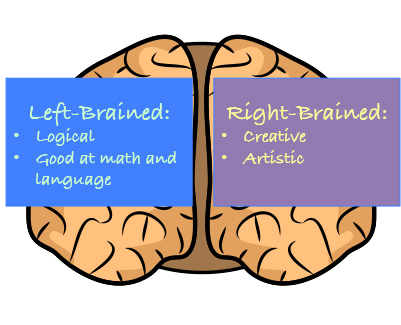
I have heard many times that we can be left-brained or right-brained. Not only is this not true, it isn’t helpful in dispelling the myth that we are intrinsically ‘good’ or ‘bad’ at anything.
According to the theory, tasks carried out by the two different sides of the brain are either logical, language-based (left brain) or creative and artistic (right brain). The theory would suggest that we can be either logical or artistic, but not both.
The Science of Learning debunks this myth for us by explaining how inefficient it would be to have a powerful processor at our disposal and only ever use half of it. The reality is that we tend to use both sides in the course of a day, but may be primarily using one or the other at a time.
Switching things up to make studying easier
This is important to note when studying, as we can fatigue our brain by forcing it to use one side or the other for hours on end. If you have just spent an afternoon of double maths and physics and come home to write an essay, your left brain has probably lost the will to live and won’t cooperate. However if you spend some time making a mind map with images and different colours to plan your essay, your right brain will step up and give the left a break, so that you can still be productive without fatiguing your brain.
When you have something to complete and it feels like your mind is wading through fog, try switching to a task that uses the other half of your brain.
It is also useful to use checklists for tasks that you do frequently. This can allow you to complete them without having to use the logical part of your brain to plan them effectively, so saving some mental juice for the task itself.
Bear this in mind when planning your studies to make better use of your energy.
How do you get in the zone? I’d love to hear in the comments 👇👇
Optimising a home study space can make a big impact on achieving study goals. But what can you do to make a difference?
Not every child has equal access to education
Students are spending more and more of their study time at home. We may not be in lockdown right now, but is still the need to isolate for many families. There has also been an increase in the uptake of homeschooling having spent so long out of school in the past year.
Not every student has a quiet, comfortable place to study at home. This can have a big impact on their productivity. Without access to the internet, or an internet connected device, without a quiet space to sit and work, or with caregiving responsibilities, clearly not every child has an equal access to education.
You can learn more about the barriers to educational success in society, as well as how you can contribute to make a difference, at https://www.suttontrust.com/support-us/.
Productive zen or crumpled chaos?
But even if your child is one of the lucky students to have access to a laptop and somewhere to study at home, they don’t always make the best choices, and could do with some guidance in optimising a home study space.
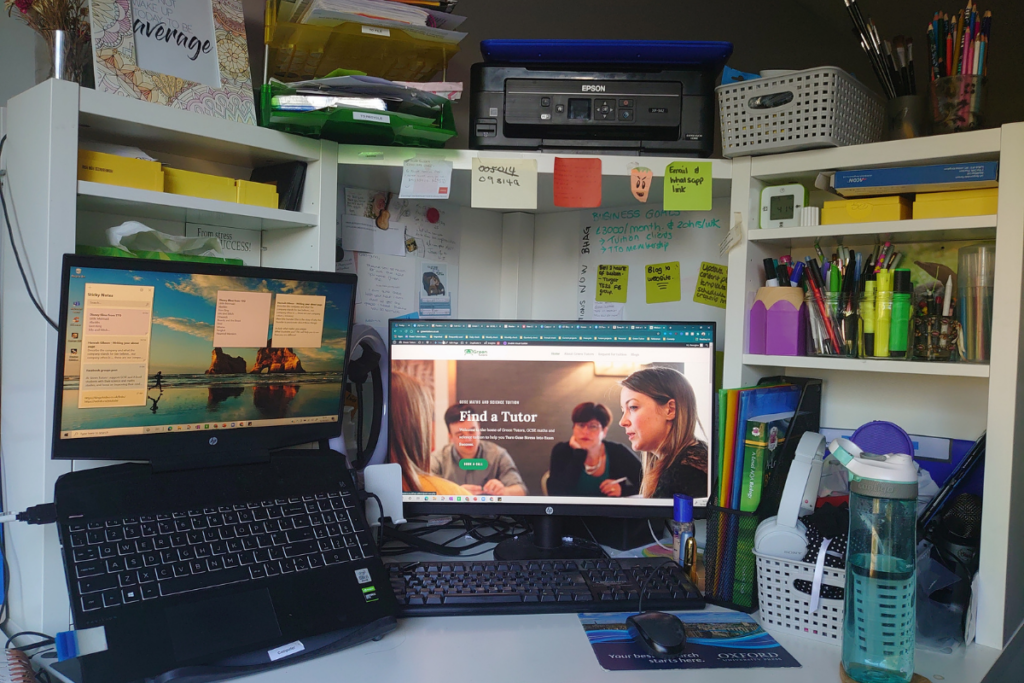
It doesn’t need to be anything fancy to make a difference. I have a desk in my living room, as I’m going to be spending most of the day at it and I want it to be comfy!
Georgina’s home working desk
Many students work on their bed, which is not ideal:
Sleep and work space should be separate to encourage quality sleep
Beds filled with pens and snack crumbs aren’t ideal for a comfortable sleep
Homework can get lost under the bed/pillow/cuddly toys
There’s no writing surfaces
Posture is poor
A lot of students work on their dining table, which can work well if it is set up well. But this is less effective if this is the hub of the house and there are lots of comings and goings. Every interruption can mean 20 minutes of focus lost as the brain gets back into ‘the zone’.
How can you improve your study space?
If you have desk space at home, can you work out a system to share it so that everyone can schedule their work and rest time? If you’re working there during the day, can it become the homework space in the evening? At least that means you won’t stay working into the evening!
If time management and planning is an issue, you might find some helpful guidance in my blog on 7 Ways to Master Time Management.
It helps to have a comfortable chair to sit on while working, so there’s less fidgeting. Dining chairs are not usually made for sitting in for hours. A swivel, padded chair with back and lumbar support and armrests is ideal. You can create a similar effect with cushions.
It is also good if there are doors that can shut out noise from the rest of the house. If that isn’t an option, noise cancelling headphones also work well. I use these: https://amzn.to/3FIRsqi.
I also have things on my desk to motivate me. On one side, I have my goals to keep me focused. On the other side, I have thank you notes from my students. You could put up quote cards, your child’s study goals, a picture of the University they want to go to, or the job they’re hoping to get. Anything that helps to keep them focused and positive. The Little Box of Calm has a great selection of uplifting messages, plus a stand so that you can rotate them day to day. I tend to stick with ‘Focus on one thing at a time’.
Is there anything you could do today to make a more productive study space at home?
Need some extra help?
If you have a great study space but your child still struggles to stay focused on their revision, it may be that they need a plan to help them to set their direction from the start. Its very difficult to get started when you don’t know what the first step is. You can book a revision masterclass with me to get a personalised study plan for the year ahead, and lots of tips and guidance on how your child can make the most of their revision time.









Recent Comments