One of the main reasons that students put off studying is that they don’t know where to start. Building tasks into a schedule and setting up positive habits for your wellbeing can take the mental energy out of the equation, so building a revision schedule for wellbeing becomes a process to follow from one day to the next. I regularly take students through this process in my Revision Workshop, and I’ve summarised the process here.
How much time do you have each week?
The first step is to work out how much free time you actually have each week. There are 168 hours in every week, but you split them between:
School
Travel
Sleep
Mealtimes
Extracurricular activities
How much time do you need to take from your 168 hours for each of those?
What is left over? Can you allocate one third of that remaining time to study? (Splitting it between work, rest, and play).
I would encourage you not to scrimp on sleep. Teenagers generally need around 9 hours of sleep each night, which is more than their parents, as they’re still growing and developing their brains. This is very important for processing everything they’ve learned in the day so still counts towards the revision plan!
What are you studying?
This is a nice and simple task. Make a list of the subjects you are studying.
For most students, this will look like:
Maths (Foundation, Higher, Functional Skills)
English literature
English language
Biology (Triple / Combined)
Chemistry (Triple / Combined)
Physics (Triple / Combined)
Humanities (History / Geography / R.E.)
Modern foreign languages (French / German / Spanish / Italian)
It would be helpful here to also note the exam board and specification. If you’re not sure, you should be able to get this from your teacher or tutor, or post it in the Facebook group and I’d be happy to help.
Take a look at where you would like to be for each of these and how far you are from achieving that at the moment. This will help you to prioritise your time through the schedule to those that need the biggest push.
Now that you know how much time you have each week to study, and where you need to focus your attention, you can start to build your weekly revision schedule.
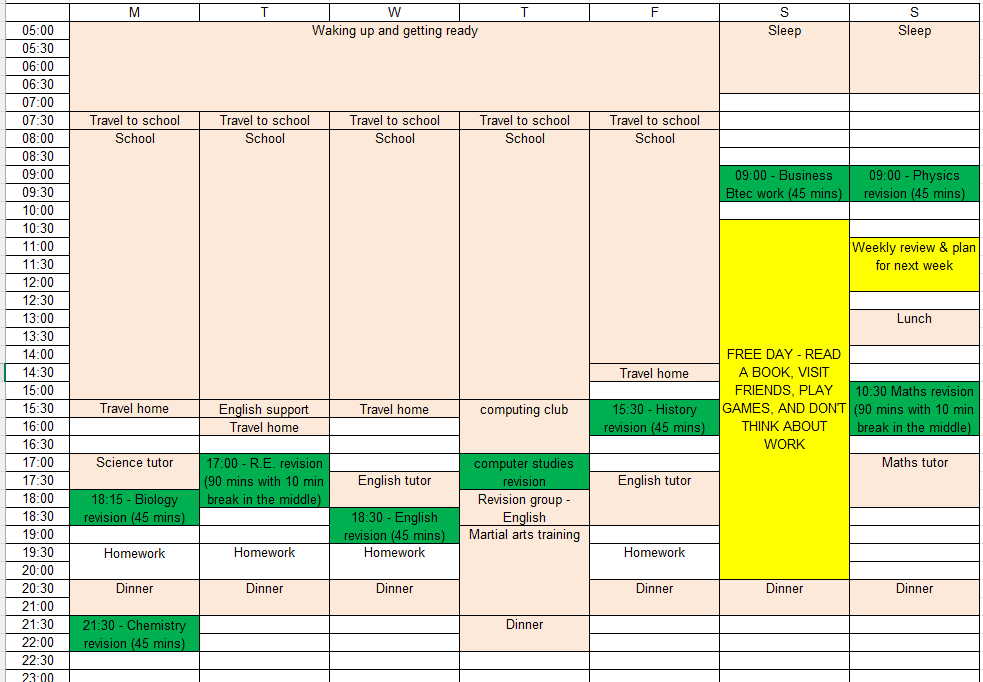
The best place to start is with a default diary. Set up a template of a weekly calendar (if you already use a weekly calendar online or in a diary you can use this, but you’ll need to have enough room to add detail). Fill into this calendar the weekly commitments you already have. This is for an average week, so don’t worry too much about ad hoc events.
Remember to add in time you give to:
School
Travel
Sleep
Mealtimes
Extracurricular activities
Then you can fit in your revision schedule around the default diary, being mindful of the times when you have energy, the times when you are able to work well, and the times when you will need rest. For example, if you have a sports club and after school study on Monday night, will you be getting up early to study physics on Tuesday? Be kind to future you and you will be more likely to stick to the plan.
Example revision schedule
ADHD and revision schedules
Students with ADHD often find it much harder to make and stick to these revision schedules. They may struggle to sleep, and it will be difficult to switch focus from one activity to the next. It is much better to focus on one task per day, and allow time for plenty of rest before bedtime.
Design a diary for holiday studies too, but be kind to yourself!
What comes next?
Everything becomes much less daunting with a plan, and if you’re able to follow through these steps with your child they should start to feel more in control of their workload. You can also get a copy of our day by day planner from Amazon to take you through these steps.
All of the team at Green Tutors are passionate about STEM education. We’ve all chosen to study and work in STEM fields, and choose tuition to share our passion for learning STEM with our students. STEM learning, and student wellbeing are the two pillars that this company is built on.
So it will be no surprise that we’ve accumulated a LOT of STEM resources and connections in STEM education since starting business in 2012.
STEMazing is the creation of Alexandra Knight, and its mission is to empower women in STEM to shine and inspire young people to become our next generation of innovators and problem-solvers. Alexandra Knight is an award-winning engineer, presenter and diversity advocate. She is a Chartered Engineer, Fellow of the Institution of Mechanical Engineers, Fellow of the Women’s Engineering Society, a Royal Academy of Engineering Visiting Professor at Brunel University and a STEM Ambassador.
One of the reasons girls do not consider careers in STEM is because there are not enough visible role models. I was lucky enough to join the STEMazing Women Inspiration Academy in 2022, and became one of the role models delivering live online STEM sessions to three different primary school classes. Here is my role model video.
The STEMazing Kids Club allows you to bring interactive STEM sessions into your home. They’re targeted at primary aged children, but I had a lot of fun doing them at the age of 38, so they’re fun for everyone.
I have been a STEM Ambassador with STEM Learning for more than a decade now. They deliver support for STEM learning across the UK in a variety of ways, including teacher CPD (continuing professional development) in STEM subjects, bringing STEM role models into schools as part of the STEM Ambassador Programme, and providing bespoke, long-term support for groups of schools through ENTHUSE Partnerships.
Schools can register to receive free support from STEM Ambassadors, or use the resources on the website. They also offer a directory of various other STEM resources across the internet.
As they have been providing this support for a long time now, they’re experts in supporting barriers to STEM Learning, and a very hard-working team.
Little Crafters Boxes is the work of Radha Borthayre, a former GCSE and A level computer science working with SEN students who found the boundaries of mainstream education did not have space for her creative teaching style. With an already successful business making wood-based gifts and craft materials, Radha combined her talents to deliver a monthly STEM subscription crafts box for home educating families. The business has grown to provide a wide range of resources for all families, and is a great way to inspire your little people to learn and try new things.
Making sweets and slime as science experiments from the Beaches of Sydney right through to the Australian Bush (in a pickup truck no less!) was the ‘slightly’ unusual inspiration for Sublime Science! After ‘Mad Marc’ had been a Professional Science Communicator (maker of slime & launcher of rockets!) across the UK, Canada and Australia & been a ‘real’ teacher in a school in Nottingham… inspiration struck. Why not pick out all the best, most fun, most exciting science experiments learnt over the years, all over the world, and put them all together?… Sublime Science was born!
‘Mad Marc’ featured on Dragon’s Den with his unforgettable science parties, bringing STEM learning to the most memorable of childhood experiences. You can now book a Sublime Science party over most of England, or get a copy of their eBook to learn how to deliver your own.
Inspiring the future of STEM learning is critical to our future and our childrens’ futures. The problems of today will be solved by the next generation, and they should be encouraged to develop a lifelong love of learning about the world around them.
For more resources and guidance on supporting your child with their maths and science GCSEs sign up for the free guide here.
While many students dive into their books with the best of intentions to revise, without clear study goals they aren’t making the best use of their time. Goals are essential in order to make progress with any challenge, and help us to prioritise our time as well as measure our success. I help my students to set their study goals when we get started with tuition, and this is how we decide them.
Motivating teenagers to revise
Ultimately, teenagers aren’t massively different from their parents, except that they haven’t finished developing physically and mentally, and they are in the early days of their independence. And so, like their parents, it is very difficult to make them do something they don’t want to do. The challenge is instead to make them want to do it.
I tend to liken it to my own experience of going out for a run. I hate running. If you feel the same way about this as I do, you’ll be able to relate. But if you’re a fan of running, perhaps a different metaphor will work for you. I hate it, but I know that it’s good for me, mentally and physically, and I know that I will get a lot of benefit from doing it as I have in the past. But I don’t want to run, and so most of the time I don’t. Now when I need to go for a run – my jeans don’t fit anymore or I’m starting to get out of breath walking up the stairs – I know that just saying to myself, “I need to go for a run”, means absolutely nothing and it won’t happen. I need to focus on the reason why I feel that I need to go for a run.
I want to wear my favourite jeans.
I want to feel healthier.
I want to improve my mental health.
Those mean something to me, and those are things I want even if I don’t want to go for a run. So that is where my motivation will come from.
What does success mean for your child?
Students don’t want to sit exams. They don’t want to memorise set texts and definitions. They don’t want to highlight and underline and summarise and mind map piles and piles of information. They want to pass their exams and go on to what comes next. That’s what we need to focus on when we’re setting goals. The goal needs to motivate them, and not daunt them.
This is different for every student, and finding out what that is for your child is what will truly motivate them. Ask them why it is important to them to do well in school. Really ask them to think about what it means to them. You don’t want to hear anything that is about making someone else happy, or impressing someone else, or just ‘doing well’. That doesn’t mean anything. What will it mean for their future happiness if they are able to do well in their exams? If they pass maths and english they can go on to college to study childcare. If they get a 6 in biology they can go on to take it for A level and get into university. If they go to university they can get the job in mechanical engineering that they really want. That means something to them, and if you can get really clear about that for your child, you can keep them motivated through their exams. That is their one big goal.
Building good habits
There are often some quick wins that you can introduce to make the challenge easier. Keeping up with classwork and making good notes in lessons can make a big difference. There’s nothing worse than heading into revision and realising that all you’ve got on a crucial chapter now means nothing to you. Check out this blog on making good study notes.
Set specific study goals
Now that you’ve got a clear motivation for your child, you can break that down into their specific study goals. What grades do they need to get in their exams, and how close are they to achieving them at the moment? What grades did they get in their most recent mock exams? Do they need to go up one or two grades before the final exam? Are there any subjects where they are already at or above target? Set a specific goal for each of their exam subjects and note how close they are to them at the moment.
There’s more to life than exams
Goal setting should apply to more than exams. Does your child have anything else going on this year that they need to spend their time on? This will make it less likely for them to achieve a study goal. If you move the goalposts too far away it will kill their motivation to work towards them.
If your child doesn’t have any goals that aren’t exam focused, this might be a good time to introduce something. I don’t mean they should take on a major hobby that will add to their overwhelm. They should simply enjoy some time away from the books each week. Support them in finding time for something they enjoy, that they are good at. Remind them of who they are and what they are capable of when their confidence for study is dented.
A comfortable stretch
Once you have your child’s goals, rate how achievable they are at the moment. It is OK to have some that are going to be a stretch, but no more than 3. Ideally these would be the most important to them, as they will need the largest slice of their time to achieve. If they need a top grade in a specific subject for their further studies, but are a few grades under at the moment, that is a clear stretch goal. If they are on track for their target grade, what push would help them get closer to their big goal. Make sure that they have realistic, achievable, meaningful goals.
Excellent customer service is the best way to sell your services
In the Tutors’ Facebook group the question I’m most frequently asked is what the best marketing for tutors is. It can be a challenge for tutors starting out to grow their business in the right way. There are so many tools, courses, and resources claiming to be the ‘key’ to successful marketing. But there is no question that the best marketing for tutors is excellent customer service.
The best marketing for tutors
All marketing aims to share what you are doing with the right audience, and why they need to buy it from you.
But while we’re trying to share that, the entire commercial world is doing the same thing. Customers get used to filtering out clear ads from view.
Which means that the best marketing for tutors is happy customers who are happy to refer your services to their friends. Those friends are most likely to be just like them. They value a recommendation from a friend over any advertising. Its a powerful selling resources.
Understand your target client
It is essential to truly understand who you are talking to in your marketing. Offer what they truly need, and communicate in a way that will resonate with them.
This will be a work in progress throughout your time in business, and you may even change direction. I make sure to understand all of my clients . Look for anything they have in common in order to better understand them. I seek their feedback on their experiences with studies and anxiety to give me ideas on how I can further help them.
How can you deliver a quick tutoring win
Building a positive relationship early can make a big difference with your clients. When I first talk with a potential client I seek to offer them something I can offer for a quick win. For example advice, a referral or a particular resource that will help them. Even if it turns out that you can’t support them with what they need, they’ll still have a positive view of you. They will still be willing to refer you to others. It can also help you to refine what you offer as it relates back to my first point – understand what your client needs.
This customer service does not end once tuition is confirmed. It is important to make an effort to connect with your students and their families. Really understand the problems they are facing. Each family is unique, but many of the problems they face overlap between clients. For the family, their situation is entirely unique. They don’t face exam preparation (or whatever you are supporting them with) on an annual basis, as you do. Your insight is more valuable to them than you may realise. You would do well to share it when you see fit.
You might also send messages of encouragement, seasonal cards, or even gifts to let them know you are thinking of them outside of lessons and invoicing. It means more than you might think to know that you are seen as a person and not just a client.
Check in with them regularly
Make a dedicated effort to ask your clients and students how they are doing. Its all very well having this as part of your onboarding sequence, or email automation, but there is nothing quite like a personal conversation to see how people are really doing. There may be little concerns that don’t warrant an email or an impersonal form response. You will learn a lot more about your customers and how you are meeting their needs if you give them the time to trust you are interested in hearing it.
Delivering excellent tuition is the minimum a customer expects from a tutor. What more can you do for them?
Don’t forget them when their tuition is complete
While it is important to give your time to your paying clients, they don’t drop off the face of the Earth when their tuition is complete. Remember to check in occasionally. Remember their birthdays and send messages or cards. Send well wishes as they move through the steps of their academic career, and forward anything you think may be of interest to them. This doesn’t have to take up a lot of your time. A couple of messages per year will more than suffice. It will help them to see that you remember them as more than a client, and their family is important to you. They’ll be very happy to refer you to any friends and family, and will keep you in mind for as long as you are in touch with them.
Ultimately the best marketing for tutors is to really understand and support your clients in the best possible way. The better you understand them, the better you can support them. The more impact you can have for them, and turn them into your biggest cheerleaders.
When you picture your child working with a tutor, what does it look like? Do you picture them at the kitchen table with a man in a tweed jacket? Or have you considered the many benefits of group tuition? All too often group tuition is overlooked as the low-cost alternative to individual tuition, but it offers so much more than that and I’d like to share those benefits with you today.
Group tuition (Canva image)
What does group tuition look like?
Our group classes are delivered online, to make it easier for your child to attend. They’re usually small groups of 2-5 students on a Zoom call together, all working at the same or similar levels on the same subject. The students are assessed to make sure that this is the case, and the group is well matched.
The lesson will be delivered and the task set as a group, but feedback can be shared with each individual student as they’re working, and questions can be asked in private to allow less confident students to participate.
For those students not able to attend a particular lesson, everything is recorded and shared to work through in their own time, and there is built in accountability to make sure that they are participating and benefiting.
According to a study by the Education Endowment Foundation, a charity focused on raising pupil attainment and closing the disadvantage gap in education, small group tuition can boost learning by an additional 4 months over the course of a year. Read more here.
Shared accountability
So many times in my life when I’ve been working towards a ‘stretch’ goal (something that pushes me out of my comfort zone) I’ve struggled to get there on my own.
I’ve had the best success when learning in a small group environment. Like when I joined a Personal Training group for women with three members.
Despite not being a morning person, and HATING going into the gym, I got up every weekday morning at 6am for several months and went to the gym with these three women.
I did’t want to let them down, or be the one that dropped out. The group environment added an extra layer of accountability. It kept me focused and so I worked much harder than I would have on my own.
Moral support
Everyone has bad days. On those days we can easily forget all of the successes, all of the hard work, and every time we’ve got it right. The cloud descends and suddenly everything is awful and we’re totally incapable. In our own minds.
And it can feel awkward working with a coach or teacher who is an expert in the very thing I’m finding difficult. So it becomes too easy to feel like I’m just not good at it and to give up.
When you experience those days with others who are at the same point in their journey, they can be on hand to remind you that you’re just having a bad day, it’s temporary, and don’t give up.
What’s more, being the person who gets to deliver that message to someone else is incredibly empowering for students, and helps them to believe it about themselves too.
Confidence building
In a similar way, group tuition can build your own confidence in your abilities, as you’re able to progress alongside your peers rather than at the hands of an ‘expert’.
While I discourage students to compare themselves to others as we’re on our own path, it is enlightening to see how others struggle where they breeze through, and vice versa. On the same journey there are many branched paths, and we’ll stumble in different places, and soar in different places. The group environment allows students to learn about their own strengths and even support others along the way. There is immense value in that for their confidence building.
Competitiveness
Even the meekest students have a competitive streak. I have often motivated students by telling them how their brother / sister / friend did with the same task. Of course they immediately want to do better. (Incidentally a similar tactic works against themselves – tell them how they did last month and they’ll want to beat that too.)
What better motivation than pitching them against each other in the same task in a group lesson?
However this is delivered in such a way that there can be a winner, but never a loser. Everyone’s individual work is celebrated for what it is – their own individual work.
Less pressure
When working one to one with a tutor the lesson is all about you, which means you’re in focus 100% of the time. That isn’t always a good thing, as self-conscious students or those less confident in the subject can become overwhelmed and disengage from the lesson. They then have to be brought back in after time to give their brain a break.
In a group, the attention moves between the members, so everyone naturally gets time for a brain break, time to sit back and absorb, and time to jump in and contribute.
So each individual feels less pressure to ‘perform’ in the lesson.
Fun!
One of the main aims of lessons is to make learning fun. Too much of GCSE and A level terms are focused on pressure, goals, measurement, assessment, comparison. There’s little time for fun, and often attempts at fun in school are marked as bad behaviour.
In small group lessons, there’s plenty of room for fun as well as learning. And to be perfectly honest, I think it is an essential part of the process.
We’re working to build lifelong learners with a passion for STEM subjects, and that’s not going to come out of a dry lecture followed by an exam.
But it can come out of making jokes, making personal connections, and finding the fun in learning together.
We offer group tuition at Green Tutors from February to June every year. This year we’re focusing on supporting students on the pass/fail margin GCSE maths to give them the boost they need to pass their exam this year. If you’re interested in joining us, you can sign up at https://greentutors.co.uk/group-classes/.











Recent Comments