One of the main reasons that students put off studying is that they don’t know where to start. Building tasks into a schedule and setting up positive habits for your wellbeing can take the mental energy out of the equation, so building a revision schedule for wellbeing becomes a process to follow from one day to the next. I regularly take students through this process in my Revision Workshop, and I’ve summarised the process here.
How much time do you have each week?
The first step is to work out how much free time you actually have each week. There are 168 hours in every week, but you split them between:
School
Travel
Sleep
Mealtimes
Extracurricular activities
How much time do you need to take from your 168 hours for each of those?
What is left over? Can you allocate one third of that remaining time to study? (Splitting it between work, rest, and play).
I would encourage you not to scrimp on sleep. Teenagers generally need around 9 hours of sleep each night, which is more than their parents, as they’re still growing and developing their brains. This is very important for processing everything they’ve learned in the day so still counts towards the revision plan!
What are you studying?
This is a nice and simple task. Make a list of the subjects you are studying.
For most students, this will look like:
Maths (Foundation, Higher, Functional Skills)
English literature
English language
Biology (Triple / Combined)
Chemistry (Triple / Combined)
Physics (Triple / Combined)
Humanities (History / Geography / R.E.)
Modern foreign languages (French / German / Spanish / Italian)
It would be helpful here to also note the exam board and specification. If you’re not sure, you should be able to get this from your teacher or tutor, or post it in the Facebook group and I’d be happy to help.
Take a look at where you would like to be for each of these and how far you are from achieving that at the moment. This will help you to prioritise your time through the schedule to those that need the biggest push.
Now that you know how much time you have each week to study, and where you need to focus your attention, you can start to build your weekly revision schedule.
The best place to start is with a default diary. Set up a template of a weekly calendar (if you already use a weekly calendar online or in a diary you can use this, but you’ll need to have enough room to add detail). Fill into this calendar the weekly commitments you already have. This is for an average week, so don’t worry too much about ad hoc events.
Remember to add in time you give to:
School
Travel
Sleep
Mealtimes
Extracurricular activities
Then you can fit in your revision schedule around the default diary, being mindful of the times when you have energy, the times when you are able to work well, and the times when you will need rest. For example, if you have a sports club and after school study on Monday night, will you be getting up early to study physics on Tuesday? Be kind to future you and you will be more likely to stick to the plan.
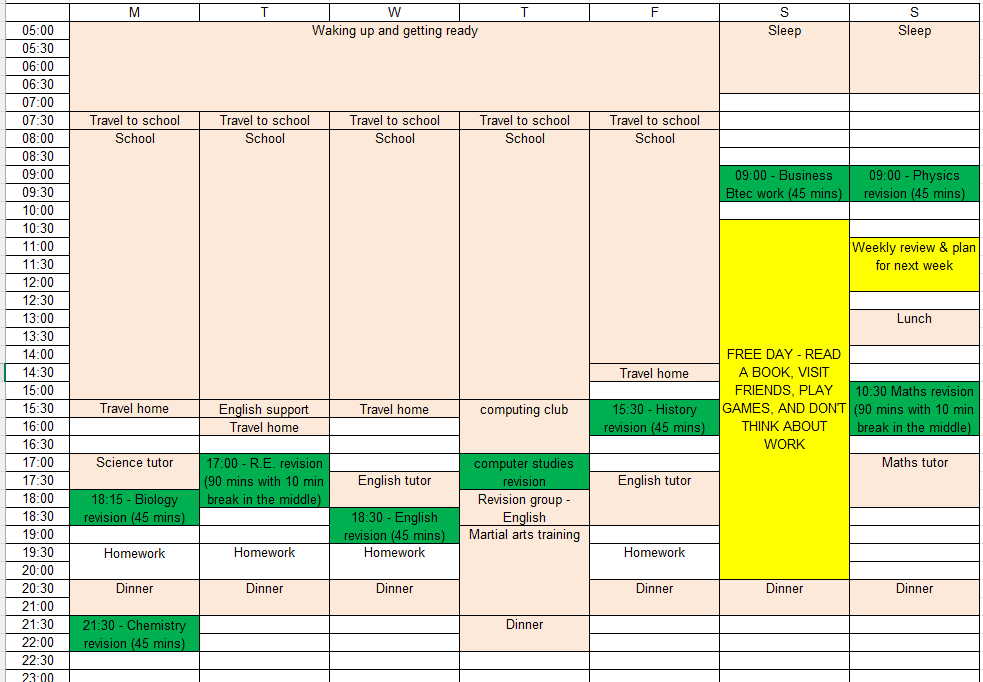
Example revision schedule
ADHD and revision schedules
Students with ADHD often find it much harder to make and stick to these revision schedules. They may struggle to sleep, and it will be difficult to switch focus from one activity to the next. It is much better to focus on one task per day, and allow time for plenty of rest before bedtime.
Design a diary for holiday studies too, but be kind to yourself!
What comes next?
Everything becomes much less daunting with a plan, and if you’re able to follow through these steps with your child they should start to feel more in control of their workload. You can also get a copy of our day by day planner from Amazon to take you through these steps.
While many students dive into their books with the best of intentions to revise, without clear study goals they aren’t making the best use of their time. Goals are essential in order to make progress with any challenge, and help us to prioritise our time as well as measure our success. I help my students to set their study goals when we get started with tuition, and this is how we decide them.
Motivating teenagers to revise
Ultimately, teenagers aren’t massively different from their parents, except that they haven’t finished developing physically and mentally, and they are in the early days of their independence. And so, like their parents, it is very difficult to make them do something they don’t want to do. The challenge is instead to make them want to do it.
I tend to liken it to my own experience of going out for a run. I hate running. If you feel the same way about this as I do, you’ll be able to relate. But if you’re a fan of running, perhaps a different metaphor will work for you. I hate it, but I know that it’s good for me, mentally and physically, and I know that I will get a lot of benefit from doing it as I have in the past. But I don’t want to run, and so most of the time I don’t. Now when I need to go for a run – my jeans don’t fit anymore or I’m starting to get out of breath walking up the stairs – I know that just saying to myself, “I need to go for a run”, means absolutely nothing and it won’t happen. I need to focus on the reason why I feel that I need to go for a run.
I want to wear my favourite jeans.
I want to feel healthier.
I want to improve my mental health.
Those mean something to me, and those are things I want even if I don’t want to go for a run. So that is where my motivation will come from.
What does success mean for your child?
Students don’t want to sit exams. They don’t want to memorise set texts and definitions. They don’t want to highlight and underline and summarise and mind map piles and piles of information. They want to pass their exams and go on to what comes next. That’s what we need to focus on when we’re setting goals. The goal needs to motivate them, and not daunt them.
This is different for every student, and finding out what that is for your child is what will truly motivate them. Ask them why it is important to them to do well in school. Really ask them to think about what it means to them. You don’t want to hear anything that is about making someone else happy, or impressing someone else, or just ‘doing well’. That doesn’t mean anything. What will it mean for their future happiness if they are able to do well in their exams? If they pass maths and english they can go on to college to study childcare. If they get a 6 in biology they can go on to take it for A level and get into university. If they go to university they can get the job in mechanical engineering that they really want. That means something to them, and if you can get really clear about that for your child, you can keep them motivated through their exams. That is their one big goal.
Building good habits
There are often some quick wins that you can introduce to make the challenge easier. Keeping up with classwork and making good notes in lessons can make a big difference. There’s nothing worse than heading into revision and realising that all you’ve got on a crucial chapter now means nothing to you. Check out this blog on making good study notes.
Set specific study goals
Now that you’ve got a clear motivation for your child, you can break that down into their specific study goals. What grades do they need to get in their exams, and how close are they to achieving them at the moment? What grades did they get in their most recent mock exams? Do they need to go up one or two grades before the final exam? Are there any subjects where they are already at or above target? Set a specific goal for each of their exam subjects and note how close they are to them at the moment.
There’s more to life than exams
Goal setting should apply to more than exams. Does your child have anything else going on this year that they need to spend their time on? This will make it less likely for them to achieve a study goal. If you move the goalposts too far away it will kill their motivation to work towards them.
If your child doesn’t have any goals that aren’t exam focused, this might be a good time to introduce something. I don’t mean they should take on a major hobby that will add to their overwhelm. They should simply enjoy some time away from the books each week. Support them in finding time for something they enjoy, that they are good at. Remind them of who they are and what they are capable of when their confidence for study is dented.
A comfortable stretch
Once you have your child’s goals, rate how achievable they are at the moment. It is OK to have some that are going to be a stretch, but no more than 3. Ideally these would be the most important to them, as they will need the largest slice of their time to achieve. If they need a top grade in a specific subject for their further studies, but are a few grades under at the moment, that is a clear stretch goal. If they are on track for their target grade, what push would help them get closer to their big goal. Make sure that they have realistic, achievable, meaningful goals.
The systems in our brain that are meant to protect us from life-threatening danger (hungry lions, Jaws) can also keep us mentally ‘stuck’ and make much less life-threatening things very difficult (revision, speaking up in class).
It is unbelievably annoying, but it isn’t your fault, and recognising that is an important first step because 90% of that ‘noise’ in your brain is unjustified self-criticism. The brain bots try to prevent you from doing new, challenging things because they feel like they might present a danger, so they just keep firing off these STOP messages to keep you ‘stuck’ where it seems safer. And while it probably is safer to stay in that stuck state at the moment, it makes for a much more boring and less satisfying life.
It’s the same reason I don’t go into a gym, and why I never used to ask my teachers for help. It means reaching out and drawing attention to the areas you feel vulnerable, and the anxious brain says, ‘No thank you, stay at home please’. That is its default, so you have to arm yourself with lots of counter-messages to help keep it quiet.
Start a list of your wins.
Each time you do something that feels like a challenge, or that you’re proud of, write it down somewhere. It really doesn’t have to be major. I note a win when I go to the hairdresser, as I hate going to the hairdresser. I’ve been cutting my own hair for years over having a stranger washing and brushing my hair. That’s out of my comfort zone, and something else will be your challenge to face.
Anything can go on this list, and it will soon stack up. You’ll have a nice list of the times you thought you couldn’t do something, and surprised yourself, to show your anxious brain what you’re capable of. When you’re facing a new challenge and you hear the brain bots shutting it down, remind them that you can do this.
Ask for feedback.
You are definitely your own worst critic. Again, that isn’t your fault but it is in your control. I challenge you to seek feedback from the people who know you, and ask them to choose three words to describe you. I did this recently, and the results were incredible. I wouldn’t have picked the words I was given, but there were definite themes in the answers that helped me to identify my strengths.
I’ll bet lots of people will be willing to share that with you too, and you’ll be able to see how others see you. Then you can take a note of your strengths and use them when you face new challenges. Playing to your strengths and asking for help with everything else makes you much more likely to succeed.
Make it a habit to notice your gratitudes.
Every morning I write down 10 things I’m grateful for at that moment. A lot of the time it’s my morning coffee, or the animals, or even the fact that I got a good sleep the night before. Anything that has made you feel good can go on the list, and it helps your brain to start adopting a more positive attitude.
These things aren’t about you, but will also help you to notice the things that you’ve provided for yourself, and to keep the brain bots away from negativity. This really helps when you find yourself feeling ‘nothing ever goes right’, and you’ve got a list of all of the things that made you happy to counter that.
When the overwhelm is related to the amount of work you have to do, organising is the answer. But be warned – it gets a little worse before it gets better.
You need a clear picture of everything that’s on your plate, so start with a full brain dump. It might not feel good to see everything on one page, but I promise it’ll be worth it. Write everything you’re thinking about, worrying over, spending time on, onto a big sheet of paper (or an online document) and then work through this process with each of them.
If you think of more things as you go, you can add them to the list to follow the process rather than getting distracted.
Let it go
Are there things on here that are outside of your control? They might well be things that could have an impact on your life in the future (like who will win the next election, or will we catch flu), but there’s nothing you can do about them or in response to them at the moment, so they aren’t really your concern. They can be forgotten straight away, and you should take a moment to enjoy striking them off the list.
This is easier said than done, and sometimes it takes a little reset to get them off your mind. Change your environment, change your focus, or even take a cold shower. Give yourself something else to occupy your mind until it feels better.
You’re left with things that are inside your control only then. These are the steps I then take with my worries.
Action plan steps
Define the problem e.g. I have too many things to do and feel like I’m not in control. Important things aren’t happening and it is building up.
Think of as many solutions as possible no matter how silly they may seem e.g. delegate/drop some responsibilities, get help with something(s), extend deadlines, don’t sleep for a week (don’t do that one)
Consider the pros and cons of each solution. Do the benefits outweigh the consequences?
Choose a solution to try.
Plan how you are going to implement the chosen solution. Be specific about the action steps, and when. For help with setting these steps check out https://greentutors.co.uk/goal-setting/.
Review how it went. Were there any problems? Was it the right solution to choose? What did you learn?
It might still be a lot, but you’ll feel more in control. And you’ll be able to see where you need to ask for help, and who you can ask.If you find you’re regularly overwhelmed with GCSE prep, I have something that you will love. The Turn GCSE Stress into Exam Success Planner is an all inclusive planner and study companion for GCSE students to take control of their studies and reduce any associated stress with positive habits and a plan of action. You can be the first to get your hands on one with a special offer on the waitlist at subscribepage.io/TS2Splanner.
Every school student has notes from their classes, but what those notes look like varies more than the UK Government advice on face masks.
Making study notes
Some students write down every word that the teacher says, in the hope that they’ll make sense of it later.
Others write down a title and then spend the rest of the lesson chewing the pen and staring out of the window.
Some of my teachers used to put study notes up on the board for us to copy down. Cue shouts of, “Miss, what does that say?”
It doesn’t inspire confidence that they actually understand what they’re writing down, or why they need that information.
And often when it comes to revision, the go-to plan is to make a new set of study notes on the entire course. I’ve seen students spend vast amounts of time colouring in headings, creating flowery borders, and choosing the perfect pastel highlighter combinations at this point, rather than spend the time on what’s important.
So it’s fair to say that every student knows that they need notes, but not necessarily how to take and to make notes that will help them.
Active Revision
I am always telling students that they have to use active revision methods for effective learning. But what does that mean?
Active revision is about actually processing the information through your brain in a conscious way so that you are moving more of it from your short-term memory to your long-term memory.
How can you do that?
Before you make your notes, you need to understand what you’re writing about. So I sometimes tell students to look at a video on a topic, or I’ll explain the key points to them, so we can have a discussion on it before they transfer it into a set of notes.
I can then review those notes to make sure they’ve captured all of the key points they’ll need, and explained them correctly. If they’re working alone, they can check the notes against the course specification.
That way, they’ve moved the information into their long-term memory at the same time as they’ve created a set of notes they can use before the exam to review the information and recall anything they might have forgotten in the meantime.
Look after your future-self
Future you will be delighted that you’ve made a great set of notes up-front. As soon as possible after learning a new topic is the best time to create that set of notes, while it is fresh in your mind.
Also, it means that you can create that bank of notes over the entire course, rather than the last-minute cramming period before the exams.
At that point, you’ll be experiencing heightened levels of stress and anxiety, perhaps having trouble sleeping, and feeling the pressure of deadlines. There are also lots of emotions around that time of year as students spend less time in school, and start saying goodbye to their friends. If you can take something out of the mix by getting started early, it’s a great idea to do that! Look after your future self with a little extra work now.
Highlight anything that’s missing
Following these good note-taking and review practices means that you will be able to spot anything that’s missing early on. I encourage students to check their notes against the specification to ensure they’ve covered all of the required content. If you can see that you’ve completed an entire topic but there’s a key element missing, you can reach out for help to fill that gap early on, rather than finding out later. Again, this will reduce the last-minute stress.
It may be no surprise to parents to hear that the biggest issue most students face is with their confidence.
It’s nothing unique to them either. We all face crises of confidence when we learn something new or push out of our comfort zone.
The reason we call this a comfort zone is that it is uncomfortable to leave. But that is where growth happens.
But to encourage students to take that step, there have to be mini-successes lining the path to build their confidence.
And so it is important for students to have someone to hold their hand a little along that path. I make sure those successes happen by setting the pace for them, keeping them away from overwhelm.
Tracking progress
When I look at a goal I’m working towards, it is easy to be put off by how big and scary it looks from the beginning of the journey. We can’t see the route to it, or imagine ourselves reaching it. And so it is easier to just decide we don’t want it and ignore it
You might see this in your child with emotional outbursts. They might have a lack of interest in school and studies, not want to talk about school or act up in lessons. Lack of confidence might spill into other areas, and you might notice they’re self-conscious about things they’re usually comfortable with.
It’s easy to decide Netflix and chocolate is a better option than going out for a run. It’s just as easy to then get angry that my jeans won’t do up anymore. We know that the short-term brain is no friend to long-term success. But we make these choices in the moment anyway because they feel better.
Students make those choices every day with their school work. I can’t even tell you how many times a student tells me “I can’t do that” before proceeding to do exactly that. And it doesn’t change their attitude because they’ll tell me they can’t do it again 5 minutes later.
So it’s my job to tally up those little wins as we go and keep reminding my students of them. I lay out the steps for them to take as they go to get closer to their goal. And when they don’t feel like they can take the next one, I turn them back to look at all the steps they’ve taken so far and give them a little nudge forwards.
That’s 90% of what tutoring means. It doesn’t matter what we know, how fast we can do sums, how many words we’ve memorised. It is just important that there’s someone there who understands the path you’re taking and is prepared to support you through it.
Goal setting
Rather than looking at the big daunting task of ‘passing exams’, break your goals down into small steps that can be achieved in one day.
If I want to complete a sponsored run (unlikely) but have never run before, I might sign up for a ‘couch to 5k’ program, go out on training runs with a friend, perhaps even a coach, and learn about what’s involved first.
Exam prep is no different. Your goals should be broken down into manageable steps that build to the end goal. Review the exam specification to know exactly what to expect, find out the dates in advance and plan your revision time, and have supportive friends and family around you to keep you on track.
GCSE students usually haven’t sat exams before, so they don’t know what to expect. That’s why practice papers help, even when they’re unpopular. The more familiar something is the less scary it becomes.
Keeping positive
The human mind is exceptionally complicated and powerful. It can feel like a minefield at times, but we have more control over it than we think.
A positive outlook really makes a difference to success.
It has long been reported that attitude is the biggest factor to success. If you don’t believe you can do something, you’ve already lost the battle.
But how do you get a positive attitude about something you far?
A generally positive outlook makes a big difference. And you can build this by adding little habits into your routine.
Every morning, make a list of ten things you are grateful for.
Every evening, note what you did well that day.
Make a list of ten things you like about yourself.
When doing these things becomes a habit, we’re encouraging our brains to be more positive overall, and it keeps us to see positivity in more places and experiences.
It sounds really cheesy, and it’s easy to pass off as rubbish, but it doesn’t cost you anything to try and I think you’ll be surprised!
Community support
I know it can be hard to make changes to your habits, especially when you don’t know where to start.
I run a Facebook group to help students and their parents make a plan for their revision and to stay motivated.
Have you ever had the experience of being so totally involved in what you were doing that you didn’t notice what was happening around you? Perhaps you didn’t notice that the sun had gone down and you were now sitting in the dark. Had you perhaps skipped dinner entirely? If so, you’ve experienced getting into ‘the zone’ or flow state. You were so entirely focused on what you are doing that it is almost an art form. This is something that you can emulate when studying to make studying easier. It also reduces the effort required to get motivated each time.
Getting into the zone to make studying easier
Flow state
Named by the psychologist Mihály Csíkszentmihályi in 1970, the term ‘flow state‘ describes a particular mental state in which an individual is so completely focused on one task or activity that they disconnect from other stimuli (both internal and external).
I’m sure you can imagine how being so thoroughly engrossed in one single activity can be beneficial to your productivity in that activity. Without distractions, day dreaming, or self-consciousness the mind is able to focus all of its efforts onto one single goal. To be in that state when studying would allow significantly more progress in the time available.
So what is required to get into this flow state?
This is something often associated with elite athletes, such as those in this Telegraph article. But you can just as easily use it to make studying easier.
According to the productivity tool Asana, it is a simple 6 step process.
Balance challenge and skill.
Establish clear goals.
Reduce distraction.
Stop multitasking.
Don’t force it.
When in doubt, do something you like.
It is no surprise that these are the elements of the Revision Workshop I can offer you if you are struggling to get started with revision. If you can set clear goals aligned to your ability and longterm goals, and create the right environment for study, most of the battle is won. It even includes the requirement to enjoy oneself in the process, which is a key part of our tutoring at Green Tutors.
What does it look like?
In order to better understand the process, let’s go back to the expert, Mihály Csíkszentmihályi. He tells us that the following six factors define the flow state experience:
Intense and focused concentration on the present moment
Merging of action and awareness
A loss of reflective self-consciousness
A sense of personal control or agency over the situation or activity
A distortion of temporal experience, as your subjective experience of time is altered
Experience of the activity as intrinsically rewarding
Immediate feedback
Feeling the potential to succeed
Feeling so engrossed in the experience, that other needs become negligible
How can students create this?
These things might feel far removed from your experience of studying, but this is where we must clarify the difference between school attendance, homework, and personal study time.
When you set aside time to study you are taking control of your learning experience. This does not tend to be the case in a classroom environment, guided by rules intended to manage behaviour in large class sizes. Your timetable, classes, clothes, goals, and even lunch are out of your own personal control. This is the opposite of the flow state, and can build a negative association with the learning process.
In taking control of your goals in the time you do have a say over, you will be able to recreate this sense of ease around the learning experience, and focus on the things that you personally will find rewarding for your longer term goals.
Clearly this needs to happen in an environment where you can spend an extended period of time away from distractions or demands. If this isn’t something you have at the moment, this article may help you to create it.
But we also have to remember to give time for all sorts of activity and avoid burnout. Believe it or not, there is more to life than studying.
Left/right-brained activity.
I have heard many times that we can be left-brained or right-brained. Not only is this not true, it isn’t helpful in dispelling the myth that we are intrinsically ‘good’ or ‘bad’ at anything.
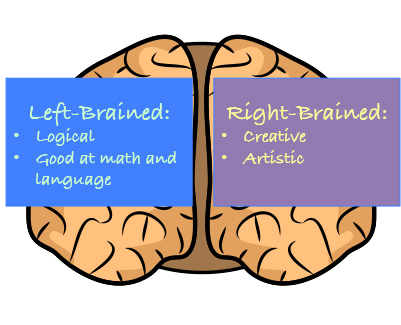
According to the theory, tasks carried out by the two different sides of the brain are either logical, language-based (left brain) or creative and artistic (right brain). The theory would suggest that we can be either logical or artistic, but not both.
The Science of Learning debunks this myth for us by explaining how inefficient it would be to have a powerful processor at our disposal and only ever use half of it. The reality is that we tend to use both sides in the course of a day, but may be primarily using one or the other at a time.
Switching things up to make studying easier
This is important to note when studying, as we can fatigue our brain by forcing it to use one side or the other for hours on end. If you have just spent an afternoon of double maths and physics and come home to write an essay, your left brain has probably lost the will to live and won’t cooperate. However if you spend some time making a mind map with images and different colours to plan your essay, your right brain will step up and give the left a break, so that you can still be productive without fatiguing your brain.
When you have something to complete and it feels like your mind is wading through fog, try switching to a task that uses the other half of your brain.
It is also useful to use checklists for tasks that you do frequently. This can allow you to complete them without having to use the logical part of your brain to plan them effectively, so saving some mental juice for the task itself.
Bear this in mind when planning your studies to make better use of your energy.
How do you get in the zone? I’d love to hear in the comments 👇👇
We use technologies like cookies to store and/or access device information. We do this to improve browsing experience and to show (non-) personalized ads. Consenting to these technologies will allow us to process data such as browsing behavior or unique IDs on this site. Not consenting or withdrawing consent, may adversely affect certain features and functions.
Functional
Always active
The technical storage or access is strictly necessary for the legitimate purpose of enabling the use of a specific service explicitly requested by the subscriber or user, or for the sole purpose of carrying out the transmission of a communication over an electronic communications network.
Preferences
The technical storage or access is necessary for the legitimate purpose of storing preferences that are not requested by the subscriber or user.
Statistics
The technical storage or access that is used exclusively for statistical purposes.The technical storage or access that is used exclusively for anonymous statistical purposes. Without a subpoena, voluntary compliance on the part of your Internet Service Provider, or additional records from a third party, information stored or retrieved for this purpose alone cannot usually be used to identify you.
Marketing
The technical storage or access is required to create user profiles to send advertising, or to track the user on a website or across several websites for similar marketing purposes.













Recent Comments